The Durham Planning Commission will hold hearings on four projects and two amendments to the UDO tonight, Tuesday, December 13th at 5:30pm. See the link for details and how to attend the meeting virtually, through Zoom. There will be a hearing on the proposed 45.945 acre Courtyards at George King residential project on George King Road, just east of Little Creek, part of the New Hope Creek basin, like Northeast Creek, and bordering the Chapel Hill town limits, between Highway 54 and Ephesus Church Road, near Creekside Elementary School. The McAdams Company is proposing up to 99 single-family homes and townhouses. Below are some comments. After the advisory Planning Commission hearing the next step would be a City Council hearing.
Also, remember to “Leave the Leaves” for wildlife and fallen leaves are also good for composting and mulch. Consider the interesting colors and shapes of the leaves (the shape varying by the amount of sunlight a leaf received, up in the sunlit and windy treetops or lower down in more shady, sheltered, and humid conditions, etc.), and some leaves hold moth cocoons or galls. I think I once read that the each leaf on a tree varies genetically, but I still need to verify that. This year might have been good for fall color, or was for some trees here, with unusually red foliage on a some branches or throughout the tree.
Courtyards at George King comments
Again the Planning Department’s staff labelled an area that is obviously part of the Cape Fear River basin as part of the Neuse River basin. Water in one basin goes to the coast at Wilmington and the other goes to New Bern, a great distance away. That error might have been fixed by now. Silt and other pollution would quickly reach nearby Little Creek and Jordan Lake. Well-known Bolin and Booker creeks join just east of University Mall in eastern Chapel Hill to form Little Creek, which flows through Durham County a relatively short distance to the Lake, which now probably covers its confluence with New Hope Creek, in the area that was part of the 751 South controversy over where the Lake is.
This area seems to be adjacent to gameland and further construction could impinge on hunting, contributing to deer overpopulation and overgrazing in the larger area. In places at Fews Ford at Eno River State Park there is very little undergrowth within a few feet of the ground, probably due to excessive browsing by deer, so it is possible to see far into the woods. There are probably large herds of deer along the Durham-Orange county line because private hunting is not allowed in the State Park and at nearby Duke Forest, though there is a hunting program at Duke Forest to cull deer. In my neighborhood it seems like the abundance of otherwise common downy arrowwood bushes has really fallen, possibly because of the deer population. I like being able to see the neighborhood deer herd, but there can be too many for the good of other species. South of Pittsboro deer are harming the reproduction of the rare white pines, a relict of the ice ages, at the Triangle Land Conservancy’s White Pines Nature Preserve. Construction on George King Road would also impact species living in the protected area that need large areas of forest, lack of human disturbance, lack of domestic cats, etc., potentially driving some away permanently. This project would increase lighting and noise in the area, again impacting and possibly driving off wildlife, perhaps species that might sometimes prey on deer. I don’t know if there are any bobcats there, but how much disturbance will they tolerate before leaving? There are supposed to be bobcats and coyotes in the Hopson-55 area, and maybe it will be possible to see how they tolerate the huge disturbance next to the gameland. Would any streetlights around George King use the new blue LEDs that have been appearing in Durham and Chapel Hill, possibly a worse source of light pollution than other colors? More than just 46 acres would be disturbed by this project, including public land. Some of these concerns were also brought up in comments on the Durham Social PinPoint. I think I’ve seen ospreys and hooded mergansers at the gameland, probably nesting, as well as beavers, and various aquatic turtles, with white buttonbush, beds of knotweed like a beaver pond, scenic red maples, mistletoe, pawpaws, various oaks and ash, baldcypress that must have been planted, maybe common and other milkweeds, definitely dogbane, a vining pea, something like a carrion flower, etc. There are at least nest boxes for wood ducks. During the first year of the pandemic, in November 2020, a large white atamasco or Easter lily bloomed after woody brush was cleared on the waterfowl impoundment dam, though they usually bloom in late spring.
Farrington Road often backs up a lot at rush hour and when there are major events at UNC and people might be tempted to cut through if George King is paved with increasing construction. The traffic sometimes backs up for miles on the main roads. It seemed like floral diversity declined and might not have returned after Grandale Road was paved in about the 90’s, and now there is a plan to increase traffic and extend the road southeast, further into Chatham County. I’m not sure that the orange butterflyweed, a milkweed eaten by monarch butterfly caterpillars, or the edible wild strawberries ever returned. I occasionally take the increasingly less scenic way along George King Road instead of Farrington. Do bicyclists use this road to avoid the high-speed traffic on Farrington? Cyclists have been killed on 54 in nearby.
The applicant or Planning staff claim that this area is not part of a wildlife corridor, despite the protected forested corridor along Little Creek and the currently somewhat rural surroundings. How many animals cross George King Road and would likely be killed if traffic increases? Grandale cuts across a known wildlife corridor, and already seems hazardous for pedestrians/cyclists/children going to the new elementary school nearby, but planners want to increase through traffic, possibly benefitting Cary more than residents of Durham.
There are long trails around the nearby waterfowl impoundment area and extending to Barbee Chapel West and north (the “Little Creek Trail System”) – could this project or sidewalks connect to those? The trails have official-looking metal signs with maps and so seem authorized.
I notice that The McAdams Company basically ignored the Community Goals questionnaire, which could be seen as ignoring the Durham community’s stated concerns. There are trails in the area, geographically relevant or historic names could be used for new roads, this is obviously part of an important natural area and waterway between Durham and Chapel Hill, with known historic buildings and Civil War sites close by, etc. The Durham government didn’t show much concern for the Highway 55-Grandale area, but maybe the community will see more of a need for resistance next time and the current construction is being monitored.
What about flooding, increasing due to impervious surfaces being added upstream and climate change-driven long or heavy rains? Climate change could also be an issue with any old farmponds on the site, though I hope, probably in vain, that they would be preserved or drained with a minimum of wildlife being killed. There would probably be mass grading at this currently wooded site, at whatever time of year is good financially or logistically for The McAdams Company, with little preservation of existing vegetation, presumably killing a lot of wildlife.
As was mentioned on Social PinPoint, rural residents could be driven out, and they could be considered a marginalized multi-ethnic group vanishing from much of the Triangle, depending on income. What do voluntary agricultural districts do to protect farming in Durham?
Are there any historic sites around the site, given the historic buildings and Civil War Trail sites on Farrington and Leigh Farm roads nearby, apparently related to the skirmish near New Hope Creek around April 1865?
Does the no longer applicable commuter rail corridor have any effect on this proposal?
Given that this site borders Chapel Hill, does the Town government have any comments on this proposal?
Category Archives: Conservancy
Conservancy functions preserve the quality and integrity of the natural and cultural environment of the Northeast Creek basin through research, conservation, preservation, and restoration.
Some rezoning hearings coming up this August
Below are some comments for the Durham City Council meeting tonight, August 1st, and there will be several other rezoning/annexation hearings this month, including for 4150 Old Chapel Hill Road [, at the corner with Garrett Road, among other sites,] August 9th [this is actually a Planning Commission hearing], and the Courtyards at Farrington Civil War Trails site, by the old [Patterson’s Mill] country store, August 15; see: www.durhamnc.gov/AgendaCenter/City-Council-4 [www.durhamnc.gov/AgendaCenter/Planning-Commission-15 ] There is also a Durham Rail Trail comment period and information about ShotSpotter implementation in the news.
Durham County Utility Building at the corner of Highway 55 and TW Alexander Drive
I mentioned this project in a previous post: www.northeastcreek.org/wordpress/where-the-red-fire-pink-blows-and-other-campions-in-the-triangle/ Neither community consultation meeting provided much information, though I felt somewhat better about participating in the second meeting. I thought the County was buying the site to expand the Triangle Wastewater Treatment Plant, and that is what Planning Commission members seemed to think, yet now it is supposed to be a County administrative building. I think WWTP expansion was denied at the meetings, but I could be mistaken. Given that the site was a large hill, there is probably very hard, possibly igneous, bedrock just under the surface and it would be difficult to build on. The treatment plant was rattled back then, according to the staff, and there might be the possibility of damage from renewed blasting. The area is “culturally significant” for me, and presumably for the people who once lived there, and it wasn’t merely clearcut – a large, wooded hill was blasted away night and day more than 10 years ago to build something like 540, with the remainder reportedly being dumped in the abandoned claypit across 55, now acres of mass grading at “55-Hopson” and most likely the reason Northeast Creek is quite opaque yellow at the Grandale Road bridge.
It would be good to preserve the old farmpond on the County site, where I have seen people fishing, which relates to the Community Goals and Objectives about food, accessibility, etc., though those people were probably displaced by the Council’s friends at the nearby Social Security Administration printing facility, as they have tried to do to me. These are apparently still publically-owned roads and the SSA doesn’t own any land south of the railroad tracks, on “Experiment Drive.”
I don’t know that there are any rare species on the County land now, but rare plants grow very close by and red fire pinks, seemingly very rare in Durham, grew just beyond the property lines and probably still grow somewhere in the vicinity. They might like the new openness of the site. Buttercups have been common in the still mostly treeless field where the wooded hill once was. Given that the field doesn’t seem to be mowed, is it treeless after about a decade because there is very little soil? It seems like potential open habitat for meadowlarks, a bird in decline in North Carolina.
The landscaping of an administrative building and the naming could relate to the ‘flavor’ of the local area and/or areas not built on could be managed in a way beneficial for plants such as fire pinks, but that is not addressed at community consultation meetings and probably not at Council hearings. If the site is rocky and denuded of topsoil, it might also be difficult to landscape conventionally and might require more water than usual to sustain lawn grasses and ornamentals. The Main Library had an example of probably xeric herb gardening at the entrance. A large area of mown lawn, with the lake across 55 at the WWTP, would probably attract Canada geese, possibly onto the roads.
This is also a gateway to Durham, formerly with trees and April-blooming blackberries. Other woods were cut on the north side of TW Alexander for a residential area recently and there was a residential rezoning of the old house east of the County site, another area with some wildflowers, mainly early spring woodland species, as well as some ornamental roses, though there is also invasive Vinca minor. Water from the County site drains both north and south, possiby mainly north, so where would the stormwater pond be located? The State Employees’ Credit Union branch a short distance north at the corner of 54 and Alston seems like a good example of stormwater retention pond landscaping, also attracting flocks of geese.
The farmpond drains into a clear, rocky small stream. Despite the small size of the waterway it apparently doesn’t dry up completely during the summer and so supports sunfish of some kind, possibly somewhat rare salamanders, and an abundance of crayfish, as well as having waterfalls over the igneous rock and many wildflowers.
Light pollution from the County site and 55-Hopson would impact the large area of gameland along Northeast Creek on the other side of 55. Would there be large parking lots for County vehicles, lit all night? Again I can’t remember what was said at the meetings about the storage of County equipment; maybe there won’t be storage there. Lit-up parking lots could be a hazard for migrating birds. There seem to be a lot of moths in the area, which would be adversely impacted by adding more lights. Annual National Moth Week was just a last week.
What about chemical spills near Northeast Creek, including road salt and oil or gasoline from County equipment? There might be few beaver ponds in the area to intercept a spill before it reaches the main Creek.
What does 55-Hopson plan to build across 55 near the County site? They voluntarily renounced some uses at 55-Hopson – except along 55, so what are they planning? The government allowed a text-only development plan, so there is no way of knowing now without a whistleblower, and there was just a whistleblower appreciation week. I am observing and will report any possible violations. After recent rains Northeast Creek is very opaque and yellow at Grandale Road from some source, and the hundreds or thousands of people using the Tobacco Trail every week must see it as well. Unlike in other nearby towns the land in southern Durham County seems to bleed readily when mass graded, and everyone can see.
In addition, local government wants to increase traffic on Grandale, and the DOT sprayed herbicide all over, but there is still a danger that someone will be hit by a vehicle at the narrow bridge. Given the the area is already dangerous and a known corridor for wildlife, why do the DCHCMPO’s planners think increasing traffic is a good idea?
It might be good to have an access to the County site on Experiment Drive, unless the County brings in security contractors/domestic mercenaries who behave like the SSA’s, I’m not going to be “displaced.” I think that is where the driveway to the farmhouse on the hill once was. Maybe 55-Hopson will bring over-zealous faceless corporate entity security contractors even closer, in addition to the vigilantes and the policing establishment.
East Cornwallis
Regarding East Cornwallis, from the aerial photo it does seem to be a residential area, or residential adjacent to industrial, though I didn’t know there were Cannabis growing operations in Durham. A car dealership would probably be very bright at night and there would be few trees buffering it, judging by the larger dealerships near Southpoint. On the other hand the site might already be very lit up if there are greenhouses nearby. What about the risk of oil and other toxic spills in the headwaters of Northeast Creek? A car dealership would probably heat up the surrounding area. Climate change is contributing to unusual heat waves, fires, floods, and crop losses filling the news around the world this year, but cutting trees and paving the land will increase local heating quickly and increase electricity demand. Someone commented at the community meeting about the need for sidewalks there, which is probably a good idea.
As with Hopson-55 the Morningstar Law Group is saying that they renounce some uses, leaving unclear what the intention is, though in this case it is a much smaller area and not on the edge of Durham, next to parkland. Too late to comment on Hopson-55 I heard that bobcats and coyotes have been seen adjacent, but it isn’t clear if they will still be there in a few years. I also began to worry about how much earthmoving is envisioned along 55, where there no commitments were made. Has the small area north of the powerline been cleared? They even offered not to build there at the Planning Commission meetiing if not at the City Council hearing, but it was not made a committed element, so did they clear it anyway, and for what purpose? Was all that land clearcut to create biomass fuel for European powerplants? This fuel source has been condemned by some groups. There is what looks like a very large chipper installed across from the construction entrance.
Garrett Road/751
On Garrett Road the application is for only a few townhomes, but paying a fee-in-lieu of open space requirements doesn’t sound good. While there is a vast area of what I assume is protected New Hope Creek floodplain “encumbrance” around the site, if animals need upland areas as well, those have probably largely been built on, as shown in the aerial photo. My impression is that most City or County parks are for things like athletic use, rather than to protect land that would otherwise be built on. There are parks in the Triangle that are supposed to have Catesby’s trilliums in the spring, but I have long wondered why there aren’t any in my area. If they prefer the dry uplands maybe they were plowed under by agriculture and building long ago, though for some reason not in northern Durham and Orange counties.
I expect there is a long history of people living along Garret Road, similar to how people long lived along Fayetteville Road, but they left in recent decades and the old houses have since been razed or covered up. There are also obviously thousands of years of human habitation buried in the ground, and maybe it is a matter of who knows what is buried where and a bulldozer operator probably won’t notice what gets scooped up.
The Courtyards at Farrington
Regarding the Courtyards at Farrington, coming up at the August 15th Council meeting, how can Durham allow the destruction of what is apparently the only Civil War battleground in Durham, with historic buildings, part of the national Civil War Trail and probably with designated historic buildings? What is the exact nature of the Civil War Trail designations on Farrington and at Leigh Farm, cut through by I-40? It reminds me of the NC NHP reports in relation to 55-Hopson. I saw a meadowlark near Farrington Road once, so they could be present on this grassy old farm. Unlike 100′ of woods on Farrington Road, the large hill on the County site probably did block a lot of traffic noise.
Doug Tallamy – The Living Landscape
Doug Tallamy speaks to the Tennessee Valley chapter of Wild Ones: Native Plants, Natural Landscapes 2015 Symposium. Wild Ones Natural Landscapers, Ltd. is a nonprofit, environmental education and advocacy corporation registered in the State of Wisconsin. The organization has local chapters. Its website is https://wildones.org/.
The YouTube of Doug Tallamy’s talk is here: https://youtu.be/lMxq76yv5w0.
The YouTube notes:
Dr. Tallamy is the author of Bringing Nature Home which won the Silver Medal from the Garden Writer’s Association in 2008 and the recently published book he wrote with landscape designer Rick Darke The Living Landscape: Designing for Beauty and Biodiversity in the Home Garden. He is an Honorary National Director of Wild Ones and is regarded as one of the leading voices for designing healthy ecosystems in our public and private spaces by using native plants.
Explore upper New Hope Creek around Johnston Mill Nature Preserve
The Triangle Land Conservancy’s Johnston Mill Nature Preserve, established in June 1999, protects 296 acres along upper New Hope Creek. Much of the Triangle is in the New Hope basin, including major tributary Northeast Creek, and most of the Jordan Lake reservoir, a source of water for several municipalities, sits in the valley of the New Hope River. The lower end of New Hope Creek meanders across wide bottomlands in the Triassic Basin, while at Johnston Mill the Creek, still surprisingly wide, is clear and rocky like the Eno and there are stony remains of gristmills. I didn’t see any fish when I visited in mid-February, though I also didn’t make a special effort to find them, but this should be a good place to watch fish building their nests and spawning in the spring and early summer. In February a spring bloom of algae grew on cobbles in shallow sections with the increasing warmth and daylength. Much of the surrounding forest is not especially old, though there are some large and old trees, but it still shelters many rare to threatened species and is very biodiverse; for example more than 125 bird species have been seen and there many species of early-blooming and often very uncommon woodland wildflowers. The mix of fields and old to young forest, ranging from dry hilltops down to riparian edges, heightens biodiversity and the Preserve roughly links segements of Duke Forest for species that need large areas of contiguous forest. Being just north of Chapel Hill and near Durham, this seems to be one of the TLC’s busier preserves, especially near the Mount Sinai Road entrance. I found someone’s painted #Rockhunt cobble hidden between two trees far out on the Old Field Bluff Trail.
The reddish soil has numerous rocks, metamorphic or maybe igneous, unlike the generally sedimentary and relatively soft bedrock laid down in the Triassic Basin. Jagged outcroppings, a few supporting Polypodium ferns, and exposures in creek beds reveal vertically upturned bedrock.
The TLC says Johnston Mill has beech up to 150 years old, and there are large oaks. White and Northern red oaks, along with red maples, are common on the hilltops while lower down there are large, uncarved beech and May-blooming tuliptrees, above summer-blooming sourwoods. Elsewhere sycamores, hackberries, sweetgums, shagbark and other hickories, sugar maples, ash, and three species of pine grow above ironwood, hophornbeam, red cedars, black cherries, and occasional hollies. Black walnuts are most frequent in the younger woods in the northwest of the Preserve, along a high-tension powerline, where the forest intergrades with rural farmland and a few houses. Large lianas dangle from the canopy, including grapes and trumpetcreepers, attracting hummingbirds. These massive vines probably grew together with the original woody old field pioneers, such as the tuliptrees and sweetgums. Early-blooming spicebush and painted buckeyes grow near the streams, especially in the northwest section of the Preserve. There might be fringetrees, which bloom later in April. Elms, almost ready to bloom when I last visited, and a few boxelders and birch border the creeks. Throughout the Preserve what must be crownbeard, a tall yellow composite flower that blooms in late summer, is abundant and there are the stems of last summer’s mullein, mint, millkvine, dogfennel, nightshade, and broomsedge. The NC Natural Heritage Program’s inventory of significant natural areas in Orange County says “this is one of the most pleasing forest areas of its size in the county” and “The diversity of spring-blooming herbs is also extremely high and of great aesthetic value,” and includes early-blooming Hepatica, trout lilies, rue anemones, spring beauties, toothworts, jack-in-the-pulpit, and very rare Catesby’s trilliums (I don’t think I have ever seen any trillium species growing wild). Evergreen Christmas ferns, mosses, clubmoss, wild ginger, and May-blooming pipsissewa stood out in the leafless winter forest.
Shortly after walking in from the Turkey Farm Road entrance I saw a golden-crowned kinglet fluttering, gleaning the bare twigtips, a rare sight for me, though maybe not the first time after all, and it was just where Liz Pullman’s write-up for the Carolina Bird Club says to look for them ( www.carolinabirdclub.org/birdingnc/johnston_mill.html ). A belted kingfisher loudly patrolled along New Hope Creek. I saw, heard, or found evidence of 4 to 5 woodpecker species, white-breasted nuthatches, thrushes, hawks, barred owls, turkey vultures, brown thrashers, white-throated sparrows, what I think were savannah sparrows, possibly a phoebe, and several other species. Many warblers, both summer and scarlet tanagers, flycatchers, vireos, and other birds not often seen in yards can be seen in the bottomlands, especially during migration. Turkeys, bobwhites, hawks, yellow-breasted chats, indigo buntings, and similar blue grosbeaks can be seen in the open areas. According to the NC Natural Heritage Program Inventory 21-23 species nested near Old Field Creek annually during the 80’s, including the more montane broad-winged hawks and worm-eating warblers.
Catawba rhododendrons, galax, trailing arbutus, saprophyte sweet pinesap, and foamflowers (another wildflower I have only seen cultivated) grow a short distance downstream in Duke Forest, at least partially accessible from Mount Sinai Road. There more typically western and montane plants, nesting cedar waxwings, red salamanders, and large red sumo mites meet more eastern dwarf waterdogs, yellow-bellied sliders, and snail bullheads.
Eastern chipmunks live in Duke Forest if not here, and the leafy nests of gray squirrels were very visible in late winter. A dog off-leash flushed out three or more hidden deer, and a small herd stood by Turkey Farm Road in the twilight as I left; the deer warning signs in the area are very appropriate. There were signs of beavers; river otters live in parts of New Hope Creek, possibly including Johnston Mill.
It was sunny and cold, but what were probably upland chorus frogs sang briefly near the Turkey Farm Road bluff in early afternoon. It didn’t feel that cold, but the temperature might have been in the 30’s and the wind picked up later. Marbled and spotted salamanders, Northern cricket frogs, and others breed in the bottomland while four-toed salamanders and gray petaltails, rare and primitive dragonflies, breed in hillside seeps. I saw a pickerel frog, similar to a leopard frog but earth-colored, with rectangular spots, and poisonous to other frogs, in rural Orange County when I was very young and never again anywhere else, though they can supposedly be found statewide, and they have been seen hereabouts. I am also impressed that queen snakes, a species more common in western NC and specializing in crayfish, especially recently molted, ‘soft-shelled’ ones, can be found downstream in Duke Forest.
Despite the lingering cold I found some arthropods, a small brown ant and small gray spider, as well as a large mantis eggmass, possibly from a Chinese or praying mantis, and many hackberry leaf galls. Getting to Johnston Mill small yellow daffodils, brilliant blue bluebirds, and a thrush were out as spring approached.
This is a re-edited excerpt from my article in the March – April issue of Triangle Gardener magazine, available at local libraries, gardens, and stores and also posted online at www.trianglegardener.com.
For a trail map, etc. see: www.triangleland.org/explore/nature-preserves/johnston-mill-nature-preserve
What a Wild 16 Years It Has Been
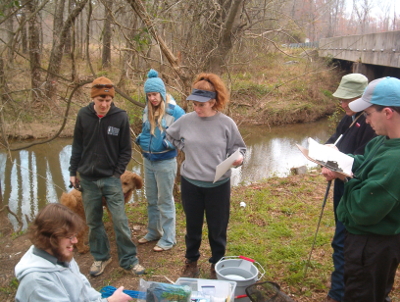
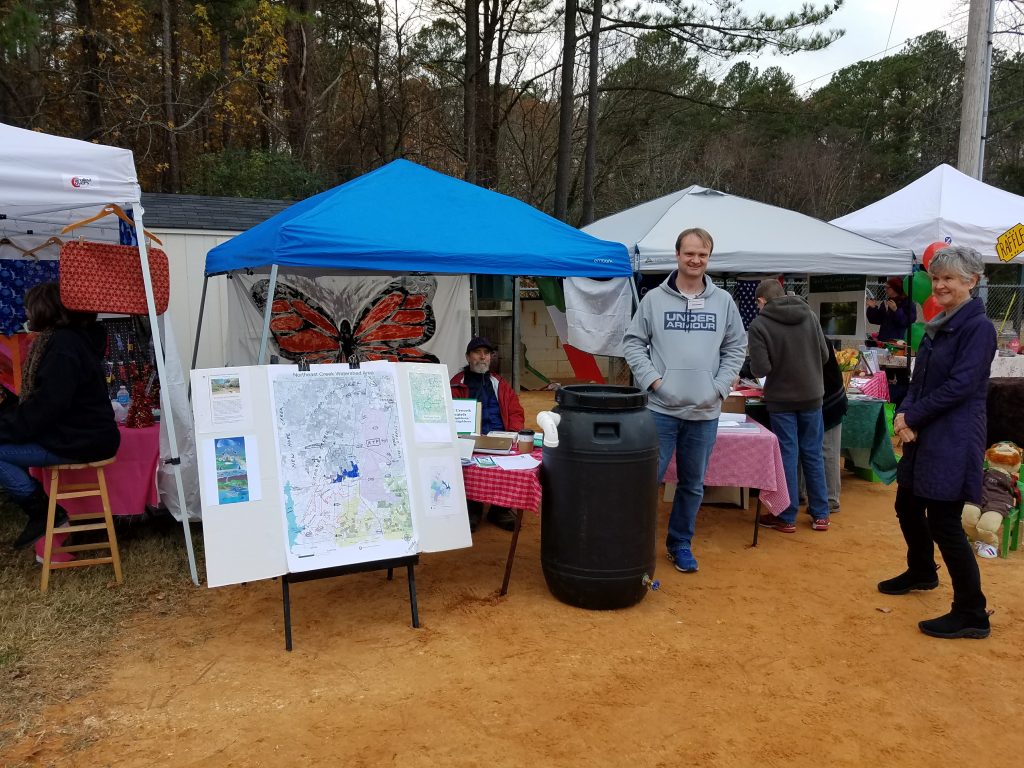
In 2005, Michael Pollock set up a table at the Parkwood October Flea Market and signed up volunteers to monitor Northeast Creek at Grandale Road and at Sedwick Road as part of a North Carolina effort to improve water quality and introduce the public to the notion of “non-point” sources of pollution: runoff from over-fertilized lawns, dog poop, litter, and the dumping of objects and litter into “unused land” including stream basins. After 16 years, we are very clear now that there is no “away” to throwing it away; pollutants stay somewhere.
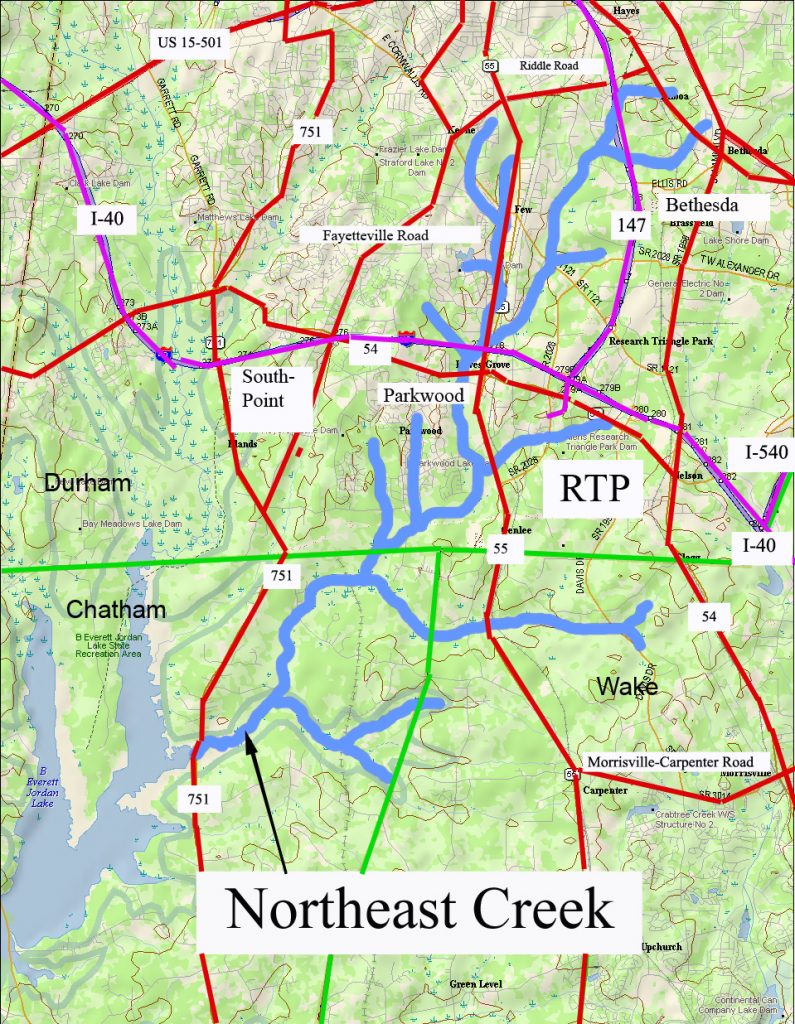
Through a “Where Is Northeast Creek?” publicity campaign with tabling, cards, and tee shirts, we became aware of the major tributaries of Northeast Creek and the relationship of the streams to roads and neighborhoods. The “four corners” of the watershed in Durham County are Emorywood (NW), Bethesda (NE), Research Triangle Park (SE), and C. J. Herndon Park (SW). The bottom corners in Chatham and Wake counties are the mouth of Northeast Creek at the NC 751 bridge over Lake Jordan (SW) and Green Hope High School in Cary (SE). In the map above the railroad track symbol that runs from the “h” in “Northeast” up to the Chatham/Durham line is the railroad that is now the American Tobacco Trail.
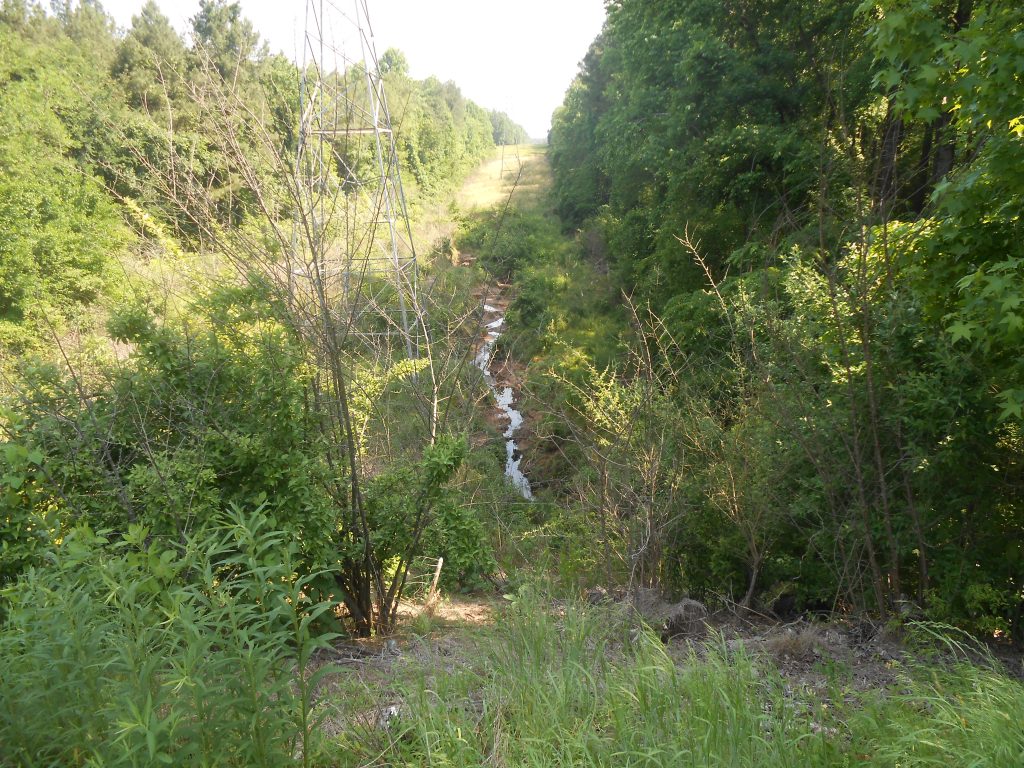
It did not take long to explore the sources of Northeast Creek, in Emorywood, Bilboa, Bethesda, Research Triangle Park, Morrisville, and Green Level.
Northeast Creek is a Triassic Basin stream that descends from the ridge between the Cape Fear River basin (Lake Jordan) and the Neuse River basin (Falls Lake). The steep slopes near downtown Durham and the North Carolina Railroad give way to wet bottom lands near the Ellis-SoHi intersection and in Meridian Park. South of I-40, the wetland alternates between braided streams and meanders with ox-bow pools. By the time it flows into Lake Jordan, it has gathered the runoff from 47 square miles of watershed. It is typical of a stream in the fall zone of the Carolina Piedmont.
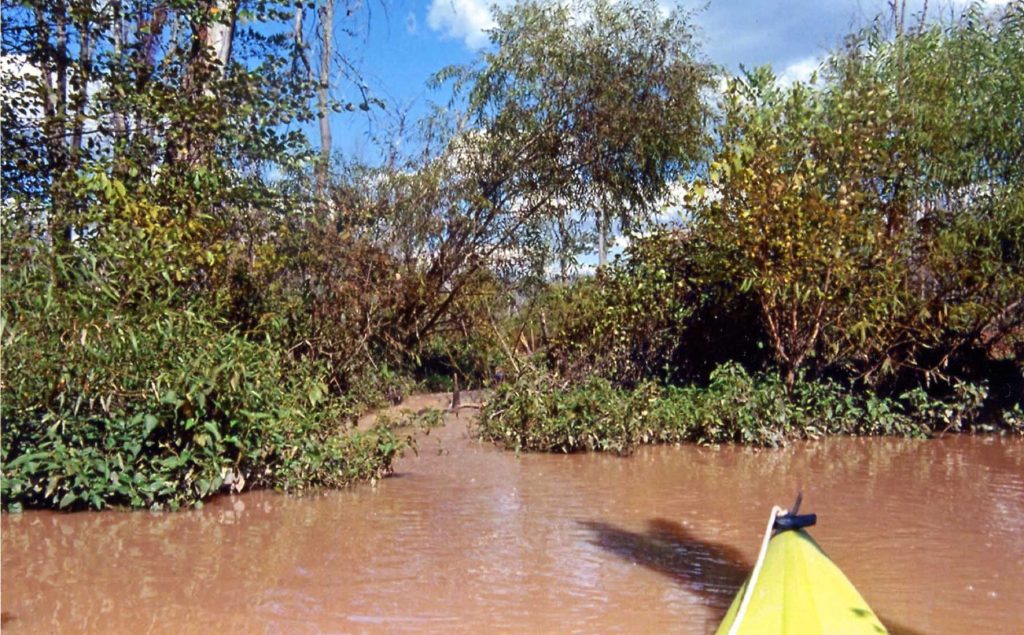
Eventually, one who lives in the Northeast Creek basin will want to see where it empties into Lake Jordan. In the 2007 drought, it was possible to walk around the lake shore to the mouth. Most often, a kayak is a more convenient form of transportation. After rainstorms, one will notice the suspended colloidal clay from the rapid runoff over bare ground that gets retained all the way to the mouth of Northeast Creek.
Water determines how land is developed. How land is developed determines the quality of water.
In 2005, Michael Pollock adopted Northeast Creek as a North Carolina Division of Water Quality Stream Watch project and coordinated with Laura Webb Smith, City of Durham’s environmental educator on adopting a part of Northeast Creek in Durham. Christine Todd Whitman, the EPA Administrator had promoted and adopt-your-stream program in 2005 that became North Carolina’s Stream Watch program. In 2007, Randal Haithcock adopted the entire Northeast Creek watershed under the EPA Adopt-a-Stream program.
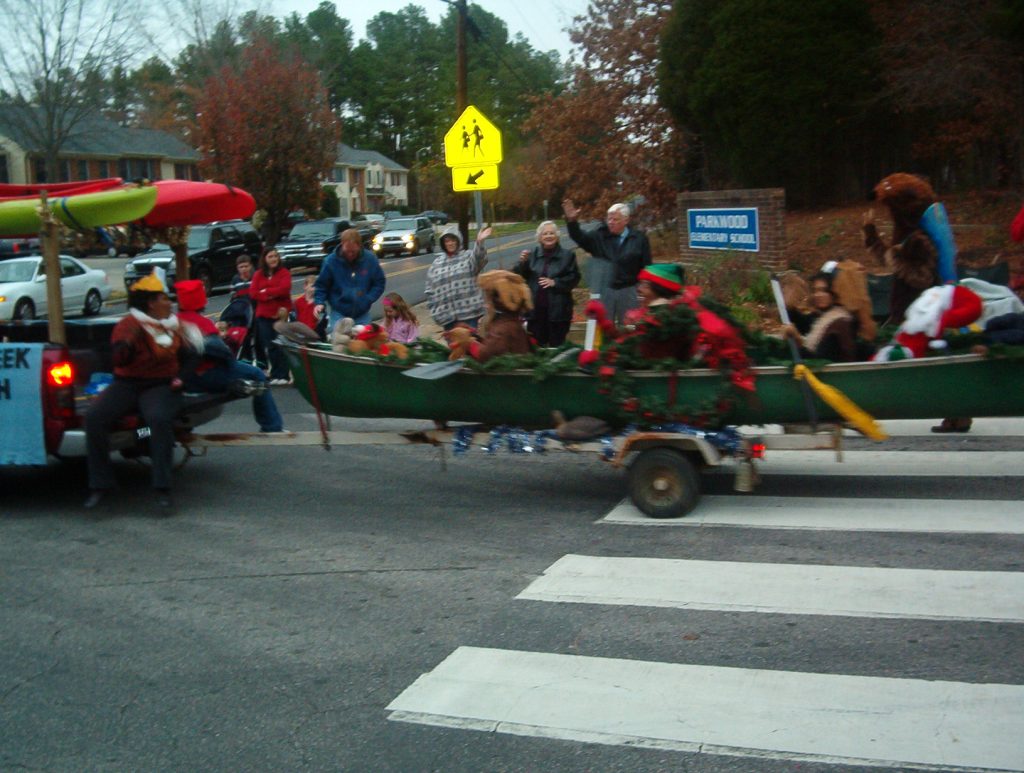
By December of 2006, it was clear that people would have to love Northeast Creek to protect and be aware of its existence if they were to learn to love it. Something about a sense of place was emerging. Northeast Creek Streamwatch enlisted volunteers from the Parkwood Library (before South Regional Library was constructed) to create costumes and ride a float in the Parkwood Christmas Parade on behalf of Northeast Creek Streamwatch.
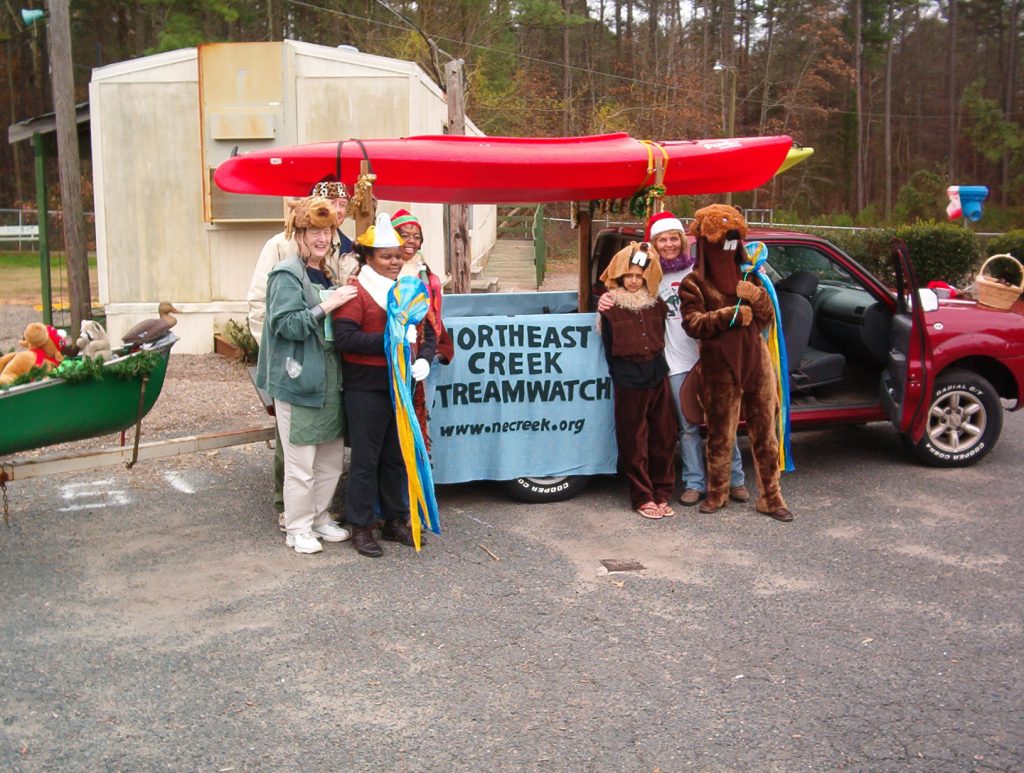
A Chapel Hill resident who was supporting Northeast Creek Streamwatch and operating Kayak Adventures, the late Susanne Gomolski offered to provide the equipment for the float, a canoe and kayaks, that she used to take tours of the mouth of Northeast Creek and other places around Lake Jordan.
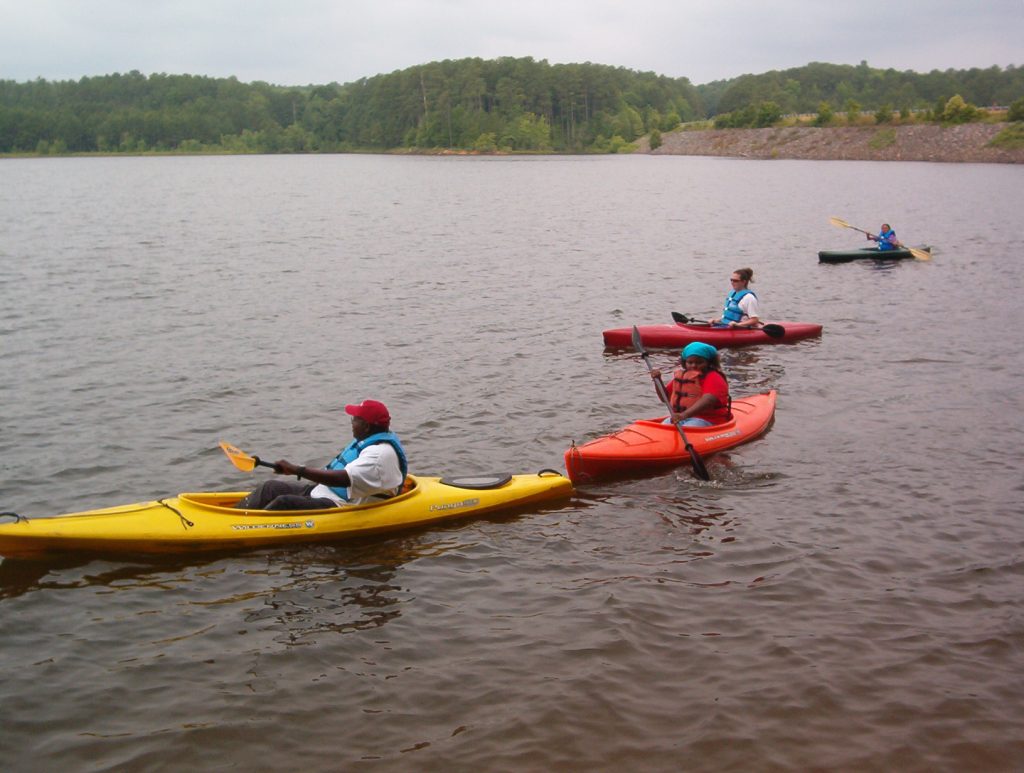
In the late spring of the next year, the volunteers who were in the Christmas Parade camped out at Lake Jordan and paddled kayaks in one of the arms of the lake. One of the thrills was seeing a bald eagle taking a fish from the waters of Lake Jordan.
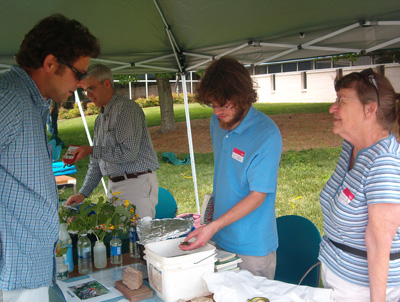
During Earth Week, volunteers from Northeast Creek Streamwatch tabled at the annual IBM Environmental Day, raising awareness about the effects of polluted water on amphibians.
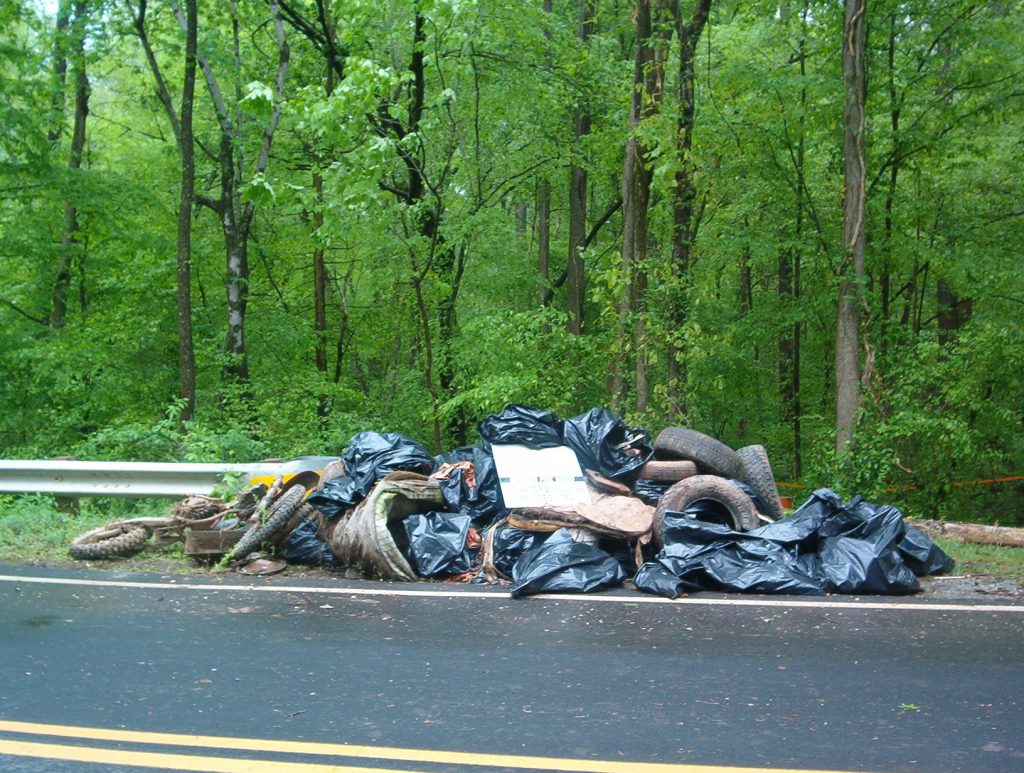
The previous Earth Day, the first major clean-up at the Grandale Road bridge netted this load of trash, including a motorcycle.
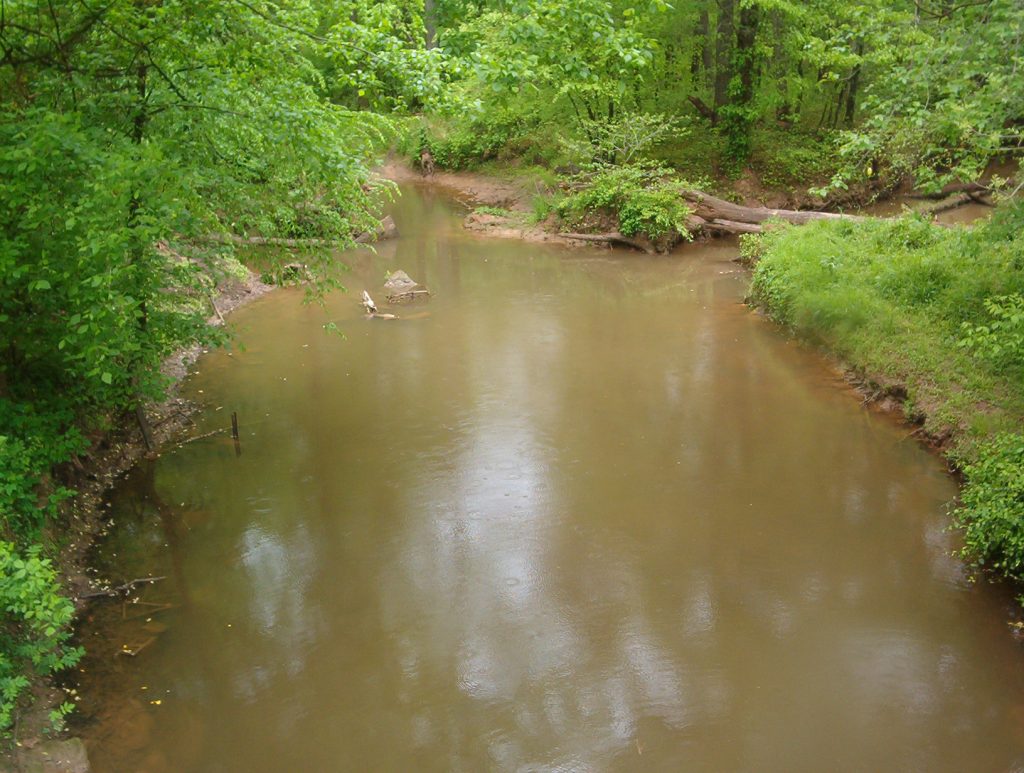
After the 2006 cleanup the creek at Grandale Road had lost a lot of trash.
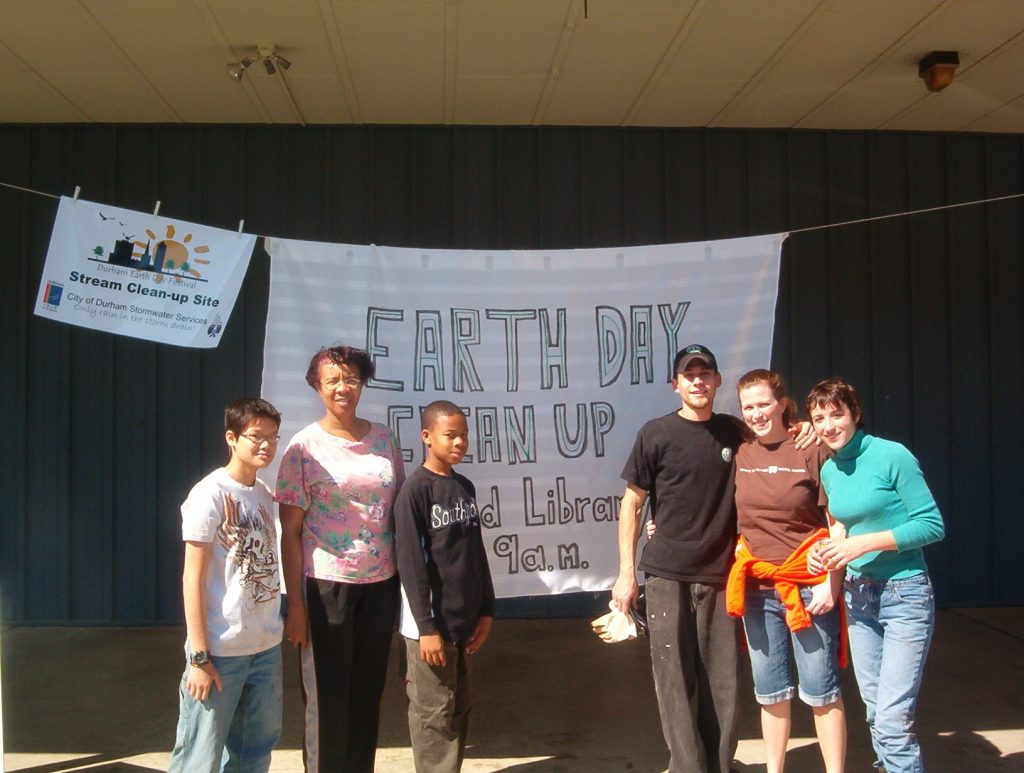
In 2007 Northeast Creek Streamwatch had a larger clean-up with over 30 people and teams cleaning up four locations; this is one of the teams.
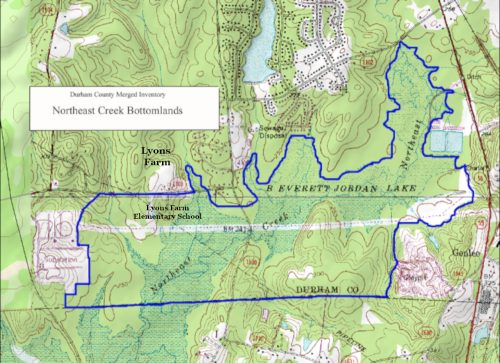
The natural heritage inventory study area for the Northeast Creek Bottomlands in Durham County NC
Advocacy began in 2006 with efforts to ensure an adequate upland buffer around the Northeast Creek Bottomlands, a Durham County designated significant natural area of plants and wildlife.
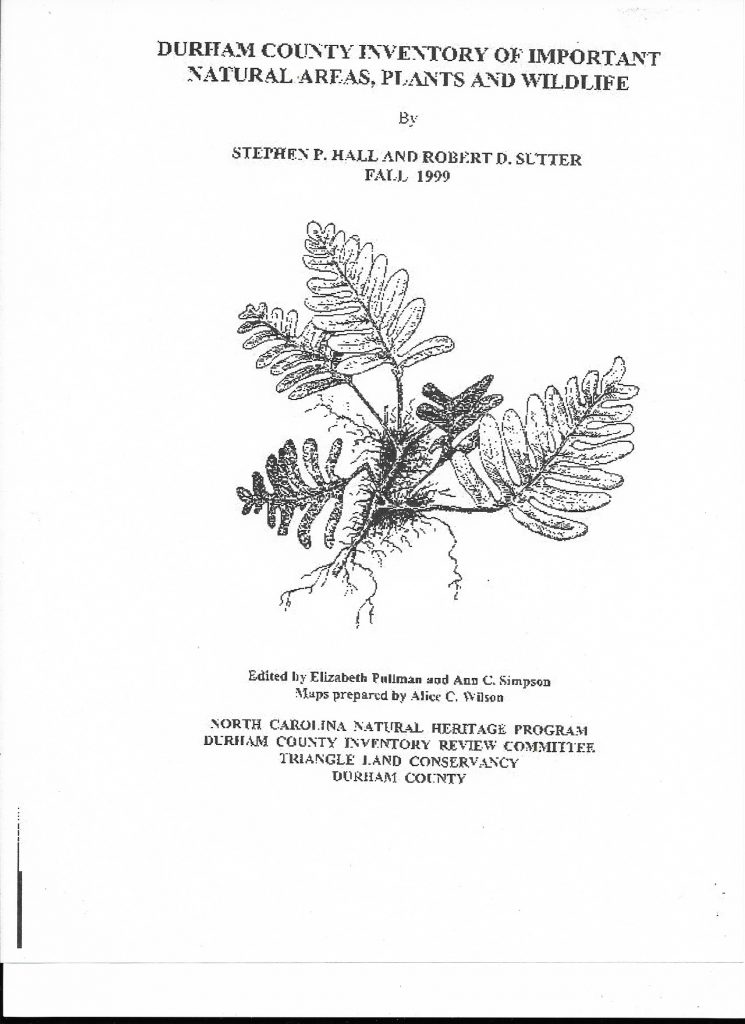
The cover of the inventory that designated all of the important natural areas in Durham County:
Our first glimpse of the property that applying to be a high-density single-family residential development looked like this view from Corps of Engineers property.
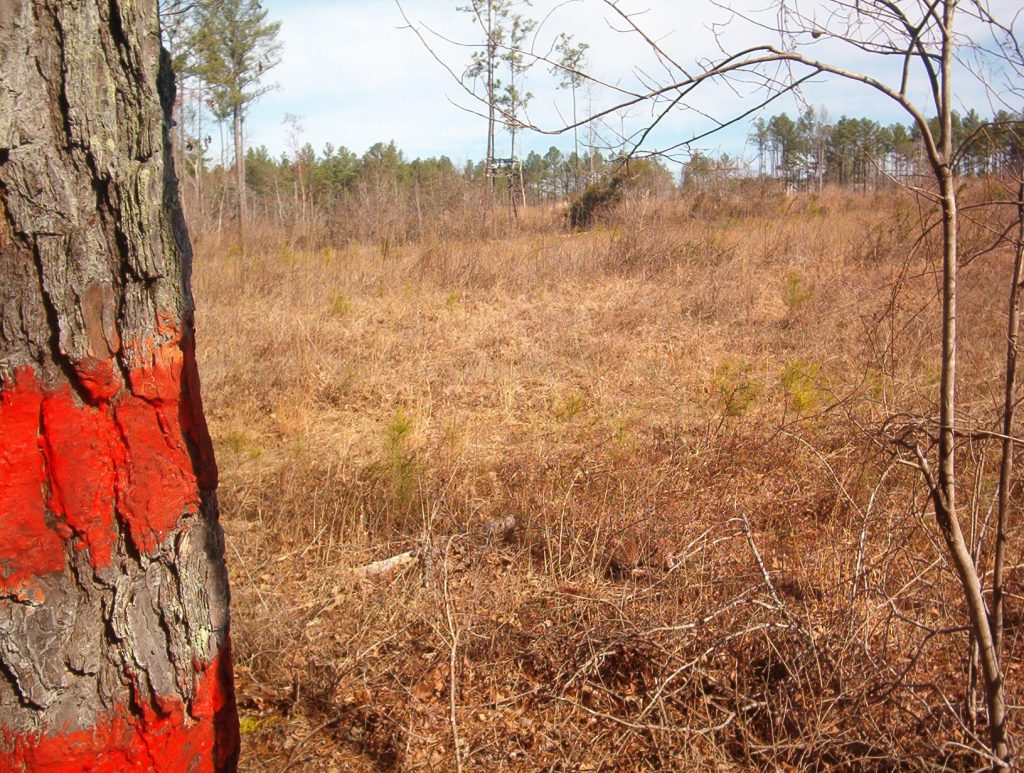
After two years of advocacy, the neighborhoods and Northeast Creek Streamwatch, the zoning proposal was withdrawn and the property purchased by Durham Public Schools as what is now Lyon’s Farm Elementary School.
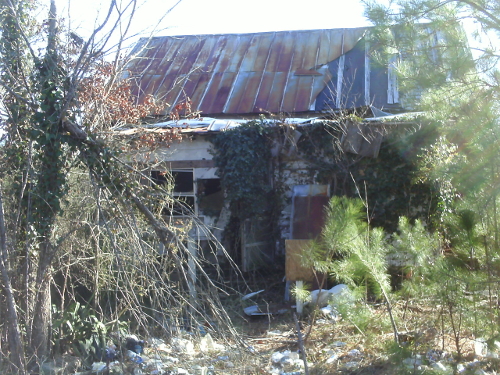
In 2010, Durham Public Schools allowed Northeast Creek Streamwatch a site visit. We photographed the farmhouse, native plants, and the area between the DPS site and the American Tobacco Trail bridge. This view of the farmhouse shows that it had an enclosed front porch and a tin roof. We are still researching the history of occupation of this farmhouse, but it might have been vacant as long as 48 years by this point.
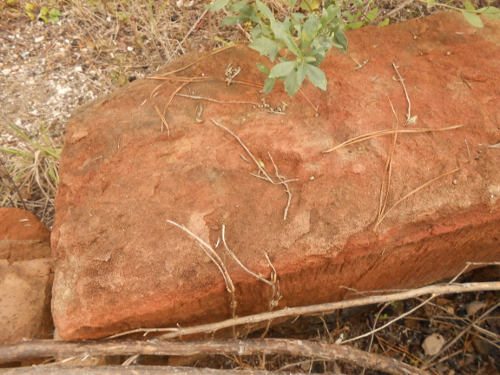
In 2015, Durham Public Schools contacted us, saying that they were beginning the design phase of school construction and had their capital and construction manager meet us to walk the site. When we did this, we found that a brush fire had burned the house and blackened some of the pine trees. In the ruins of the foundation and the cold cellar, we saw this dressed red sandstone block and decided that we needed to find out more about this house’s history.
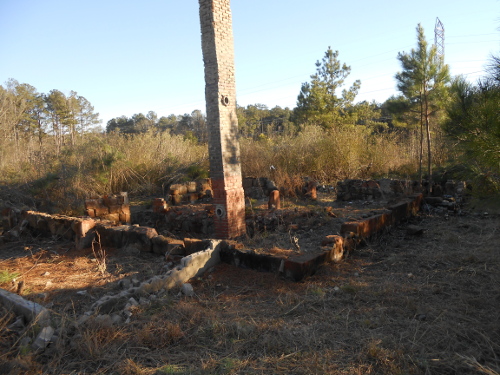
On Martin Luther King Day 2016, Northeast Creek Streamwatch volunteers cleaned the brush away from the foundations and took a picture of the exposed chimney and the cold cellar. We also contacted the NC State Archaeologist’s Office to provide a framework for any documentation or salvage archaeology. The story of this place was worth telling to the students who would attend the school; it would give them an up-close view of what history and archaeology are.
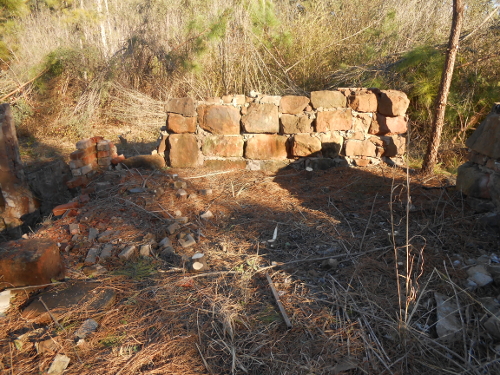
Preliminary research showed that the property was acquired in 1942 by a black farmer named Bee James; property that Durham Public Schools also acquired for this project was owned by Eddie Lyon; another tracts had be owned in the 1950s by the Pritchards.
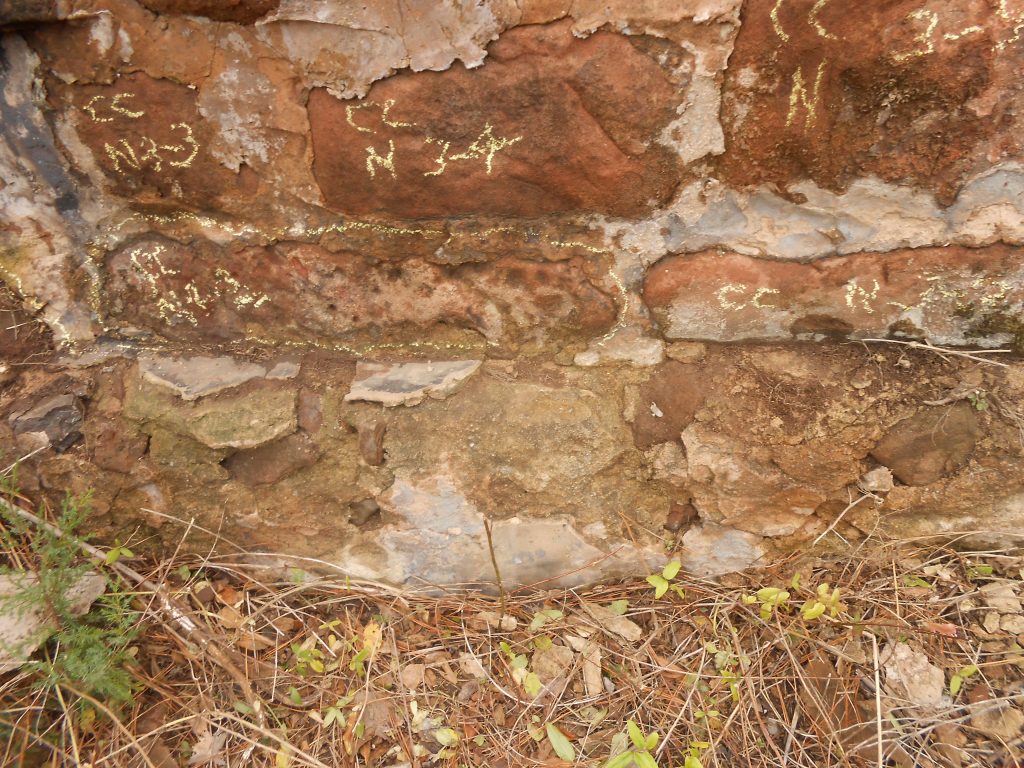
During the documentation of the old farmstead, the north wall of the cold cellar was marked to permit the option of reconstructing it. In this picture, you can see that the floor in the cold cellar was a tarpaper-coated floor boarding laid top of the first two courses of stone.
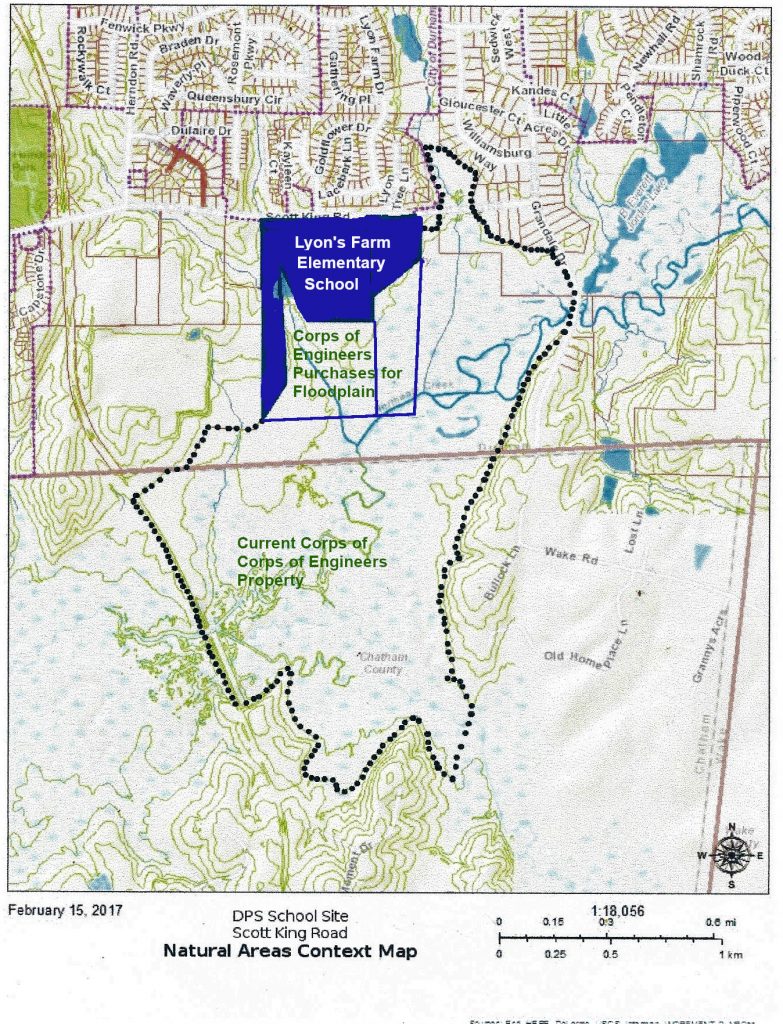
Continuous portion of the Northeast Creek bottom lands natural heritage area in the meanders between Grandale Road and a section of the American Tobacco Trail. Coming in from the southeast of the American Tobacco Trail bridge is Kit Creek (Kitt Creek).
From 2015 onward, Northeast Creek Streamwatch has partnered with the biotechnology career program at Lowe’s Grove Middle School. Two years (before COVID-19) we celebrated Creek Week at Lowe’s Grove Middle School. We also partnered with the biotechnology career program and the NC Museum of Natural Science one year in a Dragonfly Detective citizen science program.
In 2015, Cory Quammen conducted a Save the Rain workshop to showcase the work that he and Durham Soil and Water did to control the runoff from his yard. He began instructing how to make hand-made rainbarrels from recycled pickle barrels.
In 2016, the Durham Soil and Water Conservation District named Northeast Creek Streamwatch as Urban Conservationist of the Year.
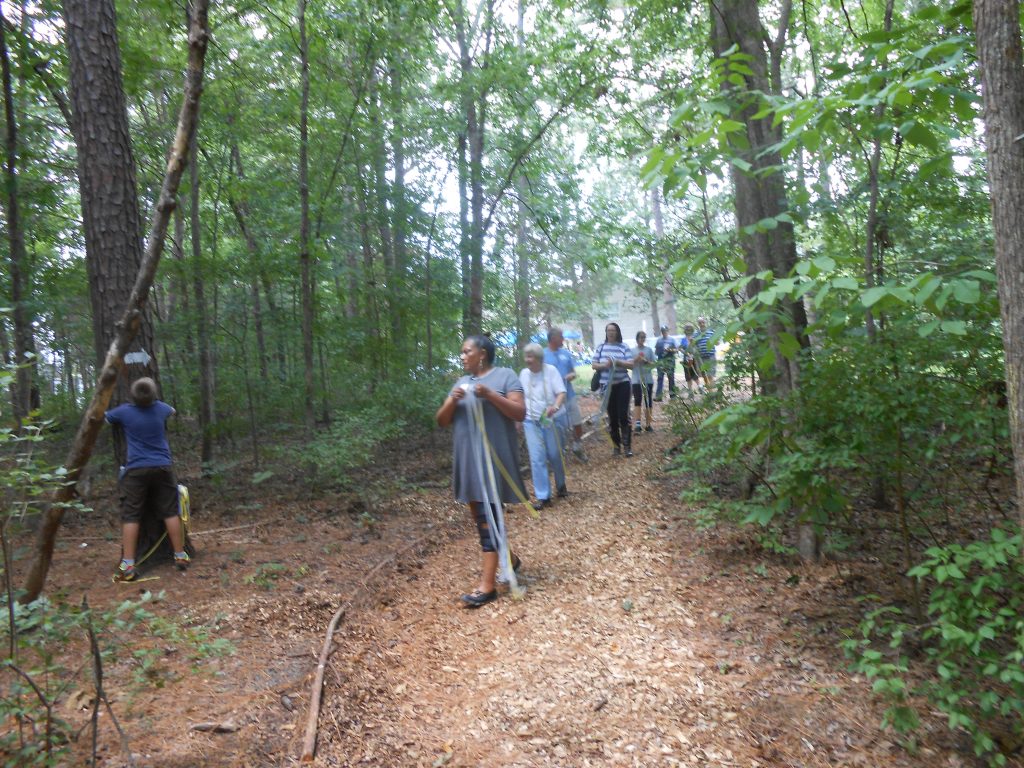
In 2017, Northeast Creek Streamwatch partnered with the Parkwood Village Association (PVA) in a City of Durham Neighborhood Improvement Program grant to reduce erosion going into Parkwood Creek (Tributary C) through construction of the Wiggly Trail and a garden of evapotranspirators next to the Parkwood Village swimming pool. The completion of the project was celebrated with a march down the new trail, with all of the participants from Parkwood Village, Parkwood, and other neighborhoods joining in the festivities.
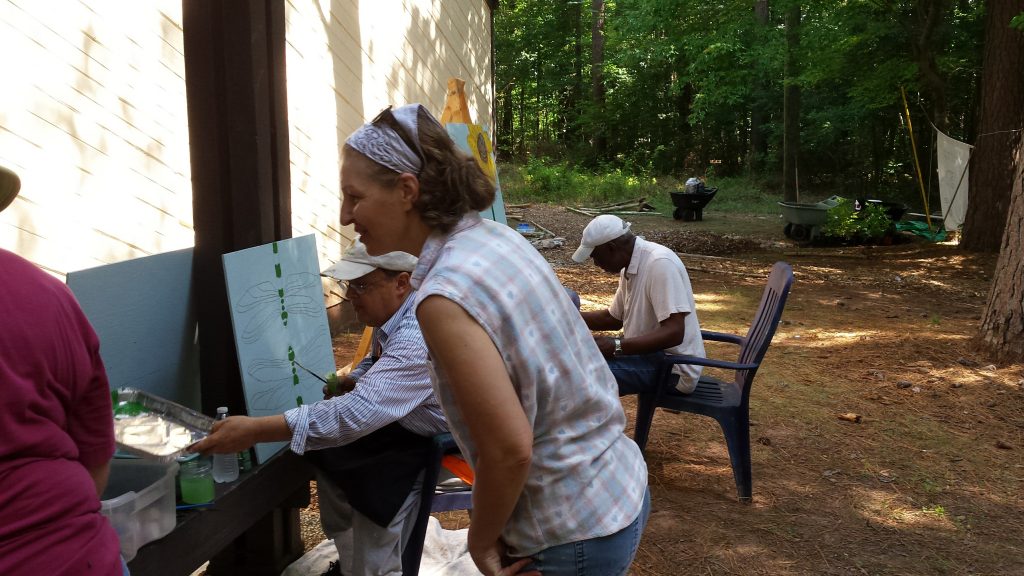
In 2017, the completion of the Wiggly Trail had a workshop for making rainbarrels and a workshop to paint pictures of native plants and butterflies
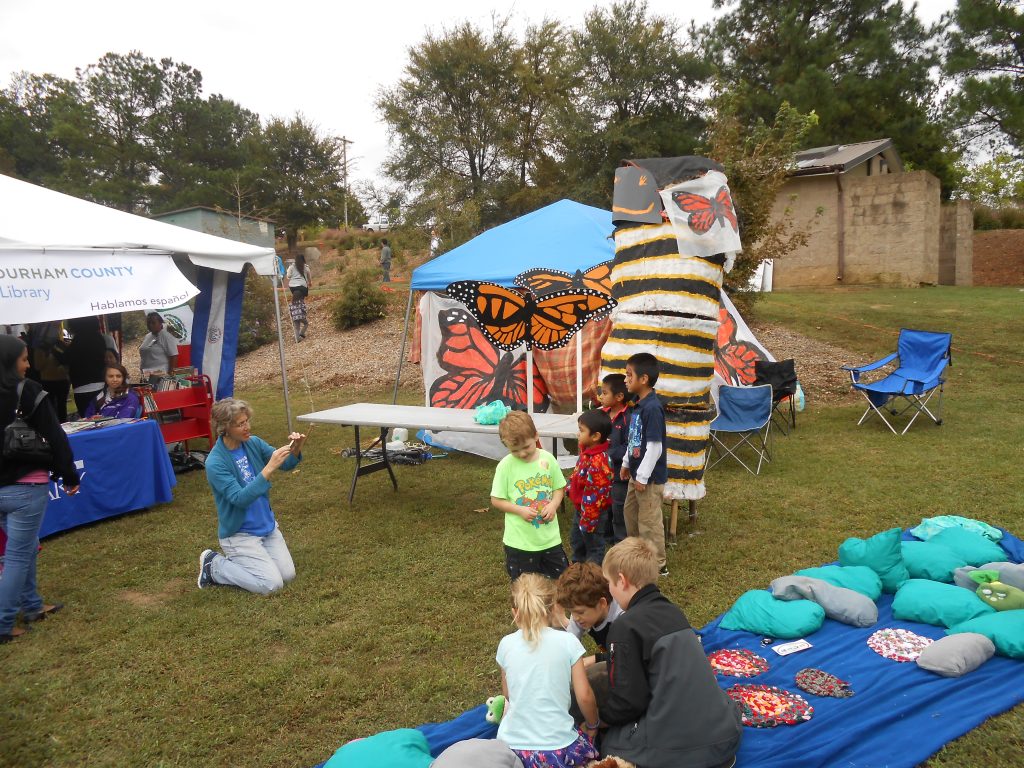
In 2018, Northeast Creek Streamwatch was one of the participants at the Monarch Festival at Sandy Creek Park. The art class at Fayetteville Street Elementary School brought a paper mache caterpillar made by students.
Cory Quammen showed a handmade water barrel and promoted the Upstream Neighbors-Downstream Neighbors program.
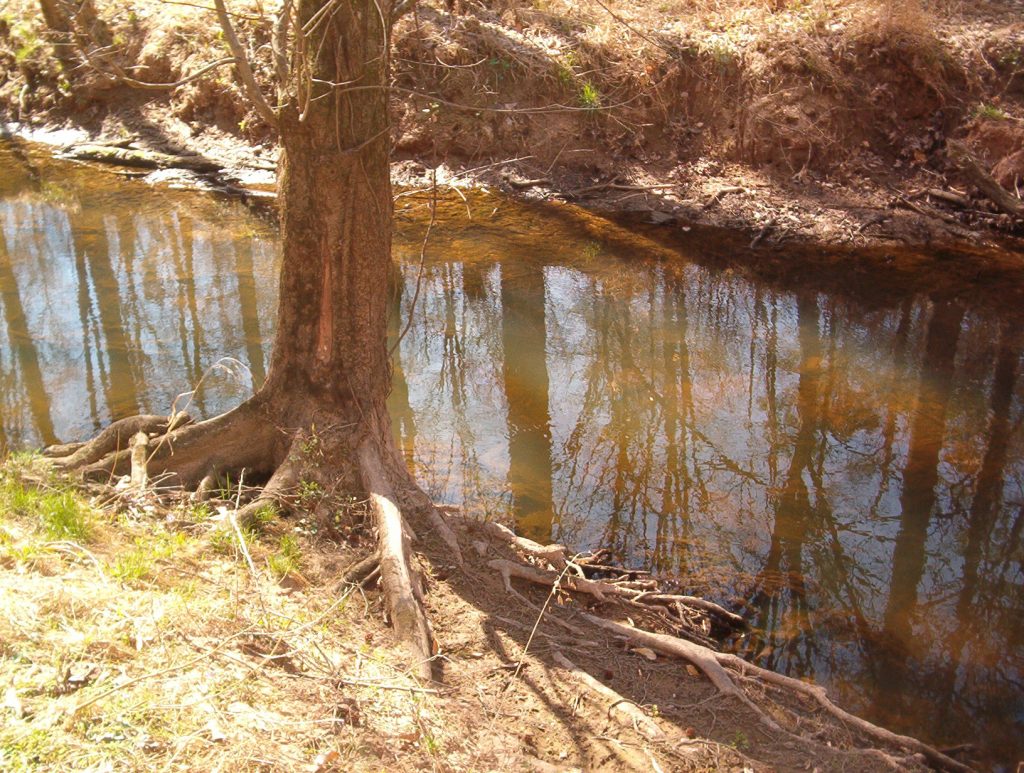
Northeast Creek in the Corps of Engineers land is a different world of plants and animals, but still shows the issues of water quality that motivates continued work.
At mouth of Northeast Creek is a multi-species bird rookery that includes this blue heron photographed by Susanne Gomolski.
NC55-Hopson Approved and Comments on proposed road extensions
Today, February 22nd is the deadline to comment on the proposed extension of Hopson Road in Durham and other parts of Amendment #4 to the Durham-Chapel Hill-Carrboro Metropolitan Planning Organization’s Comprehensive Transportation Plan: www.dchcmpo.org/what-we-do/programs-plans/comprehensive-transportation-plan The NC55-Hopson annexation and rezoning was approved, though two members of the City Council did vote against at key points (one of whom is resigning in early March); see the February 7th agenda at: durhamnc.gov/AgendaCenter/City-Council-4/ and there are videos of the meetings.
Some comments to the DCHCMPO:
I have some comments on Amendment #4 to the Comprehensive Transportation Plan, especially regarding the proposed extension of Hopson Road, and I want to clarify a few possibly related points in my February 1st comments on the 2050 CTP. I have several points regarding the Hopson and Grandale extensions, and the NC Natural Heritage Program and the NC Wildlife Resources Commission have made similar statements regarding this area, though they might not comment on this specific amendment.
I did not follow the light rail project closely and it was on the other side of Durham from where I live or might need to commute, but at the same time, I question whether it was necessary to give Duke University a veto over the project. Could a light rail route have been planned without involving the Duke Hospital area? On the other hand environmental concerns were raised along Little Creek, and I visit the waterfowl impoundment there and other areas. I suppose there will still be high density construction, even without the light rail that was supposed to justify that density. I value the public and private green spaces or vacant lots downtown, but at the same time, there is plenty of room for density in downtown Durham, where density is normal, rather than out on the fringes of the City like Farrington Road. Also, there has long been a lot of congestion around rush hour along Highway 54 where it meets Farrington Road and nearby I-40, as well as at Barbee Road, etc.
Politicians campaign on addressing climate change and other environmental issues, but then preside over the building of unnecessary and environmentally destructive roads. I have heard claims that building new roads encourages more car use, so new roads only temporarily relieve congestion, and presumably increase carbon dioxide emissions and other air pollution in the long run. Why was a Glover-Ellis connector cutting through scenic headwaters of Northeast Creek considered necessary, and if it was necessary, why was construction then allowed to block it? I thought a new residential road had been built connecting the roads. I understand that people will build what they want, consistent with laws, and that elected leaders approve rezonings, etc., but it seems like the Durham Planning Department can’t be portrayed as a passive bystander in “The alignment of the Ellis-Glover connector” becoming “compromised.”
The possibility of building the planned Northeast Creek trail is probably also becoming compromised.
In Wake County I question why town public facilities, etc. were allowed to block the preferred route of the 540 extension, so it was then built in a way that threatened the endangered dwarf wedgemussel and other species. What is the situation in southern Wake County following freeway construction? It is unclear which organizations (CAMPO? The NC DOT?) are reponsible for what decisions regarding new roads and maintenance. In Durham, who decided to cut the large, mossy red maples that lined Alston by Lowes Grove Elementary School?
I object to extending Hopson Road west to Grandale and extending Grandale south. The attached maps show the connector barely avoiding the Jordan/New Hope gameland and seemingly still cutting through a large area of wetland. If the idea is to avoid crossing the county line, Wake Road is a short distance beyond the line, so why build a new connector? Grandale cuts across Northeast Creek and is surrounded by public gameland, resulting in a lot of roadkill as is, and traffic has increased, I imagine because of Cary rather than Durham, but Durham’s landscape is to be sacrificed. I can’t remember the title now, but I saw a government document demonstrating public knowledge that Grandale crosses wildlife migration routes along the Northeast Creek corridor.
The bottomlands along Northeast Creek at the south end of Durham County are listed as a significant natural area by the NC Natural Heritage Program. The inventory reports noted nesting black-and-white warblers and probably nesting sharp-shinned hawks and the presence of ribbon snakes as rare animal species in the areas studied, as well as Douglass’ bittercress and other state or regionally rare or unusual plants, and there were river otters and mink along the Creek. The area has not been re-surveyed since 1999. Otters have been reported more recently on a tributary of Northeast Creek nearby in RTP and I saw what might have been evidence of otters a short distance upstream from Jordan Lake. I know mink live east of Jordan Lake near the Tobacco Trail in Chatham County, and along the Eno, and there have been reports of bobcats near Indian Creek at Jordan Lake, a short distance south of Northeast Creek. Apparently bobcats are easily driven out by human activity, so I wonder how close they come to my area, and without bobcats, coyotes, or hunting by humans there are few checks left on the deer population, leading to problems. Increased construction adjacent to the gameland might end hunting. Turkeys, woodcocks, wood ducks, indigo buntings, prothonotary warblers, pileated and red-headed woodpeckers live in that area of gameland and several species of amphibians breed in the wetlands and waterways. The most recent Durham inventory recommended that “Preservation of upland buffers along the edges of the bottomlands should be given a high priority. These slopes provide denning areas for terrestrial species, as well as refuges during periods of high water” while the 1999 Jordan Lake Inventory recommended that “No more utility corridors should be allowed in the area” along the Creek between 55 and 751. Did the authors not imagine that new roads, which seem worse than utility easements, would be proposed? Building a new road parallel to Northeast Creek or along other waterways would harm species that regularly migrate between the bottomlands and higher ground, such as toad and salamander species, or animals that have to move upland to escape flooding. Roadbuilding along the Eno River was stopped, but unfortuntely for Northeast Creek and fortunately for the Planning Department there are few to oppose it here in this round, though it is an election year for some local, State, and Federal officials. Would extending Hopson towards 751 or O’Kelly Church Road be in a future CTP if this goes through?
I think the complete paving of Grandale in recent decades reduced floral diversity and no doubt increased traffic, speed, and probably the amount of roadkill. Was it the DOT that cut a large oak, maybe a post oak or possibly a white oak, near the northeast corner of Grandale and Sedwick many years ago? It could be called a historic oak, from before Parkwood existed, and was left in large pieces hidden off the road. Maybe it lived when the road network was much different and what is now called Sedwick Road was forked. Now I can’t remember if the tree was cut when Grandale was paved or later. More recently Duke Energy on its own decided to cut a landmark relatively old oak, maybe a Spanish/Southern red oak, on a berm beside 751 in front of an abandoned house.
If Grandale is widened, black walunts at the south end might be cut. They are small trees, but at least one produces many nuts and black walnuts are rare trees in this part of the Triangle. In theory they could also be a food source for people, so roadwork would reduce the local food supply and the diversity of foods.
Speaking of history, there has long been a lack of clarity in what Grandale is called, and roads could reflect the landscape and history, such as in the appropriate name of the Northeast Creek Parkway.
The curve on Grandale at the bridge is already unsafe for pedestrians and cyclists and nearby Scott King Road, soon to be the site of a Durham elementary school, seems even more unsafe, and extending Hopson Road would presumably increase traffic on Scott King. Speeding far above the 25 mph limit is a problem on Sedwick Road in Parkwood, but Sedwick, Green Level Church, and Wake roads already connect 55 and Grandale. Hopson was extended through RTP to 55 in a way that made it harder to use the old Green Level and Wake Road connection. Members of my family used to be able to unicycle or bicycle along a circuit of a few miles, but South Alston was cut and is now treated as the property of the Social Security Administration printing facility on “Louis Stephens Drive” and the intersection was changed, which also destroyed a young woods with many fox (?) grapes running from the very tops of the relatively young pines down to the roadside, unusual in that the large cluster[s] of sweet black grapes were so easy to reach on those September weekends. On the other hand the large copperheads that would enter the road in late September benefitted by the road being effectively removed, if they survived a large hill being levelled, clearcutting, and a new electrical substation being built.
I don’t like the way scenic hills and ridges have been destroyed along Highway 55 there, to extend Hopson to 55 and earlier at the corner of TW Alexander Drive and 55 for fill for a freeway, possibly tolled, which I also generally oppose. That hill with an old farm house on top was blasted away day and night, leading to noise complaints from Scott King Road, and I heard that the excess was dumped in the old Triangle Brick Company claypit the Hopson extension would skirt. The spoil seems to be visible in aerial photos. Given the presence of rare plants and animals along 55, probably because of the presence of igneous rocks, what was lost on those hills over the last 10 years, and might still live on the hills west of 55?
After it was too late for the public hearings I realized that maybe Scannell’s intends to level the hills on the west side of 55 for their “business park,” to build who knows what under an Industrial Light zoning, and also making road building easier. The likely presence of dikes of very hard igneous rock would make it harder to tear down these hills. How much carbon dioxide and siltation of waterways results from levelling hills? It would be better regarding greenhouse gas emissions if businesses along 55 relied on the freight railroad on the east side, rather than locating on the west side and relying on trucks.
Would Grandale be expanded and streetlights added, possibly blue-rich, degrading the surrounding gameland for nocturnal wildlife and possibly driving species out? Blue-rich white light is especially polluting to human eyes; for example see: www.darksky.org/our-work/lighting/lighting-for-citizens/led-guide/ Except for passing aircraft little or no artificial light is visible in a large area along Northeast Creek between 55 and Grandale, shielded by the width of the gameland and the high surrounding hills. Noise pollution would also degrade the gameland, even if a road is outside of it. Grandale is audible south of Sedwick Road and what must be noise mainly from I-40 as well as highways is often very loud in other parts of Parkwood. 751 is audible from the vast expanse of gameland along lower Northeast Creek south of O’Kelly Chapel Road.
This winter the gameland along Northeast Creek between Grandale and the powerline corridor seems much smaller, because of the clearcutting around it a few years ago, and Hopson Road would skirt the south side, where there is an unusually winding and low-lying small tributary with flood-tolerant forest.
I saw a breeding whip-poor-will or chuck-will’s-widow at the school site nearby a few years ago, and I thought they had been driven out of the Triangle. What about the beaver ponds adjacent to Grandale? At times there has been a great blue heron rookery nearby and hundreds of turkey vultures and a few black vultures roosted in the summer. Construction also encourages non-native plants, and a few non-native trees have sprouted in utility corridors and clearcuts near this planned road.
Grandale also sometimes floods by the bridge during hurricanes, though raising the road would dam up the floodwaters.
The NC Wildlife Resources Commission and US Army Corps of Engineers might not comment, though Grandale cuts through the public land they are charged with protecting and Grandale, might be expanded, impacting their area. Since neighbors aren’t notified about proposed roads, people probably are not aware of what is being planned.
There is also an obscene amount of roadkill on Highway 98, especially east of Sherron Road, and along Highway 50 to the north in Wake County. Admittedly it is mostly small animals that are killed on Grandale and 54, but entire lanes are dyed red on 98 when deer are killed and two cats or foxes were left on the centerline in front of a professed church for something like half a year. Around early to mid-summer there are often brief showers or downpours just before 5pm followed by clearing, and aquatic turtles leave the ponds a short distance east of Sherron and are killed. Sometimes they manage to get to the center but then stop and are killed. I commented (assuming they received it) to some agency regarding work on 98 a few years ago. There is also a problem on Old Creedmoor Road north of 98 extending northeast to Highway 50 and on 50. I tried to be careful there and elsewhere, but I hit animals. Some how a flock of cedar waxwings that had come down to a puddle at the Highway 98 end was hit during a snowstorm, when traffic should have been moving slowly. Pets have also been hit on rural 98.
In places there have been efforts to reduce roadkill, but except for lobbying about raising the new 15-501 bridge over New Hope Creek, a few old deer and livestock warning signs, and the fencing full of holes along freeways, I am not aware of any effort at all in the Triangle or elsewhere in the State. Deeper roadside ditches and fencing might deter some animals and signs could at least be put up to warn drivers. Would intentionally hitting an animal and leaving it in the road count as littering? The speed limit is also a factor. On the other hand, there could be conservation problems if roads become impassable barriers for plant and animal species.
Roadkill and human fatalities are problems along 54 from Durham to Chapel Hill. More sidewalks and wider shoulders would be good, though I like the roadside trees, ever decreasing with dense residdential building along 54. I suppose that the shady overhanging trees along 54 where it crosses the gameland protecting New Hope Creek will be cut and will not return, if 54 is expanded in Durham. There was a shady dark green tunnel along 751 where it crosses Crooked Creek, but the trees were cut for a utility line or some other reason. Weedy verges along 54 beneficial to pollinators are also being replaced with close-cropped grassy lawn, though Durham supposedly cares about pollinators.
I also object to the way the DOT indiscriminately sprays vegetation along roads, including on parkland, even spraying trees far from the road, high branches, and herbaceous plants such as goldenrods. Issues with the shoulders and the lack of guard rails seem like bigger safety problems along straight Scott King Road then vegetation several feet from the road, beyond a deep stream or ditch. I thought a population of rare pinxterflower azaleas was safely on public land, but then the DOT sprayed them in the summer of 2017 or 2018, though fortunately not enough to kill them off.
If new roads have to be built, I would like the environment to be given more consideration. Installing streetlights next to gameland would be a problem and light pollution harms my view of the night sky as is. I have monitored the exceptionally abundant and diverse firefly population in a dark area east of Grandale since about 2008 as a volunteer with the Massachusetts-based Firefly Watch program. Would the bridge at Grandale be raised, so that animals might be more likely to go under it, as well as reducing erosion caused by the constriction of floods? Note that aquatic turtles such as yellow-bellied sliders sometimes seem to intentionally climb on to the bridge and are killed. What else could be done to reduce roadkill? Animals will be killed on roads, including pets and livestock, but I have seen little evidence that governments want to reduce the carnage, though people do sometimes attempt to assist animals or shed tears. Would there be more traffic lights to slow traffic on Grandale, Scott King, Sedwick, and Wake roads? At times many people park around the Grandale bridge to access the gameland for hunting, fishing, and hiking and it might be good if the shoulders were levelled and wider in places, though I would not want to see many trees cut. It was difficult to get the DOT to pick up wooden shipping pallets dumped just off the road next to the bridge, even though their mowing equipment was obviously running into them. Wooden pallets are a vector for non-native forest pests and diseases such as emerald ash borers, already killing trees in Durham and Chapel Hill, and redbay ambrosia beetles, which haven’t reached this far inland yet, but have sassafras as a food source as they leave the Wilmington area and the redbays and related trees near the coast. These pests can’t travel very far on their own, but have spread much faster with human help, after getting here from East Asia through shipping. One of the few benefits of the proposed extensions might be a reduced risk of roadside harassment of people legally using the gameland and road shoulders, though the traffic would be deterimental to enjoyment of the gameland to begin with.
Thank you for your consideration.
I’m not sure if it was published anywhere, but in late January I sent out a letter to the editor on the extensions, and the NC55-Hopson rezoning (approved by the Durham City Council February 7th):
Protect the gamelands along the Durham-Chatham-Wake county line
February 7th the City Council will hold a second hearing on the rezoning of an area extending from east of 55 to within sight of Grandale Road for a research/manufacturing-type “business park,” with Hopson Road extended west. Hopson and Grandale extensions are included in Amendment #4 to the DCHCMPO’s Comprehensive Transportation Plan, accepting comments through February 22nd (links at northeastcreek.org).
This rural section includes a large area of protected public land. The Northeast Creek bottomlands’ significance was recognized by the NC Natural Heritage Program, which recommended the “Preservation of upland buffers” and a moratorium on new utility corridors there.
Despite the parkland, species could still be lost. The rezoning application considers the State gameland only a “buffer.” There is no public site plan and industrial light zoning allows many uses. If large greenhouses are built, reflected light would be obvious for miles, likewise with blasting and traffic noise. What of spills? Hundreds of fireflies of several species glimmer, gathered amphibians roar, and herons, nightjars, and likely turkeys have nested nearby. If hunting ends, will deer overpopulate? I would like consideration for the welfare of this valuable, public land. Additionally, the claypit has paleontological significance. I suspect that rezoning would trigger more land sales, like the boom (of moonscaping) along Ellis.
Durham claims to care about emissions, but plans to level ridges for a redundant road. Nearby roads already seem unsafe and Grandale threatens wildlife, which the government knows. Does the Council need to see the roadkill from a short stretch [I could fill a several gallon bucket or buckets with bloody bodies on a summer night and go to a government office in the daytime or send photos.]?
NC55-Hopson and Bull City Townhomes rezoning hearing comments
Below are some comments on the NC55-Hopson and Bull City Townhomes rezoning hearings coming up tomorrow evening, Monday, February 7th, at the “virtual” City Council meeting at 7pm. There will also be a hearing on the proposed 3602 Westminster Avenue rezoning, but that project isn’t in the Northeast Creek basin. People who want to speak at the hearings have to register by 2pm Monday: cityordinances.durhamnc.gov/OnBaseAgendaOnline/Meetings/ViewMeeting?id=507&doctype=1 Most of this has been posted here before in some form. First there is a shorter summary of some issues with NC55-Hopson and then longer comments on the two proposals, mainly on the first.
Some points on NC55-Hopson
The NC Natural Heritage Program recommended in the most recent Durham County Inventory that “Preservation of upland buffers along the edges of the bottomlands should be given a high priority. These slopes provide denning areas for terrestrial species, as well as refuges during periods of high water” while the 1999 Jordan Lake Inventory recommended that “No more utility corridors should be allowed in the area” along Northeast Creek between 55 and 751.
In light of the above, where would the utilities be placed for building in this part of Durham, including along Grandale south of Northeast Creek? It seems like new roads would be worse than utility corridors.
Harm to public land and its users can be seen as harm to the public, and people can benefit from or enjoy the gameland without ever going there to hunt, hike, etc. There is also the issue of things that currently happen at little or no cost, but might become externalities paid for by the City, neighbors, etc. because of construction.
What are Scannell’s plans? Recently roads were bulldozed at the northwest end for detailed surveying, so they would appear to already have a plan for where buildings and roads will be placed, but aren’t revealing it to the public. Since last year they have been planning to begin building this spring – building what, where?
I am against the extension of Hopson and Grandale, mainly because of the impact on the gameland and wildlife, as well as already existing dangers for pedestrians and cyclists on Grandale and nearby roads, though maybe these impacts could be partially alleviated. There are already connecting roads in roughly the same place. Could they be improved, instead of building a new road? Speeding on residential parts of Sedwick Road, far above the 25mph limit, should be addressed. On the other hand it might be beneficial if parking were improved to access the gameland.
What about light pollution? Would streetlights be placed on Grandale and the Hopson extension, harming nocturnal wildlife in a public natural area? Would NC55-Hopson include large greenhouses, which would impact my quality of life, miles away, and those further away, not to mention wildlife in the adjacent gameland? Currently that area is pretty dark and except for air traffic to or from RDU little or no artificial light is directly visible in places such as the middle of the powerline corridor between 55 and Grandale, probably one reason the gameland has so many fireflies, of several species, and nocturnal birds now very rare in the Triangle have been seen a short distance away.
An increasing issue – are Durham’s new blue streetlights worse with regard to light pollution than more conventionally-colored lights?
I am against blasting levelling hills, as has happened on the east side of 55. Also, the neighbors and possibly I would hear this construction and blasting going on. I’m more concerned about traffic noise, but long periods of loud construction noise might bother the neighbors and wildlife as well.
Building new roads obviously contributes to climate change, aside from the traffic and deforestation, and it would be redundant.
Runoff and any other pollution from these projects would quickly get into neighboring Northeast Creek and then into Jordan Lake, and if something toxic to humans leaked, people live not that far away. Non-native species and GMOs would also escape into a so far relatively pristine natural area. I doubt a “business park” would be interesting in managing its property to not harm the gameland, for example by limiting lawn chemical use and the amount of close-cropped, unnaturally green lawn and non-native plants. People would no doubt be watching for violations during construction, though it is a somewhat remote area. On the other hand Northeast Creek would probably turn from relatively clear to conspicuously opaque yellow or red at the well-travelled Tobacco Trail trestle, even if erosion regulations were followed completely.
Is building around the gameland in Durham and Cary going to end deer hunting, and cause overpopulation, leading to overgrazing and danger on roads? Someone, perhaps the City or neighborhood associations, would then have to pay to control the deer population, where before hunters and nature checked the deer population at little or no cost. A high deer population can eliminate plant species from an area. Fews Ford at Eno River State Park seemed like a highly-grazed area when I was last there, which would make sense since hunting is banned in much of that part of the Triangle.
The former claypit has some value in itself and could be preserved in some form, though it would probably be difficult to erase completely anyway.
Historical names for the area and geographic features could be used in future construction, rather than naming things after “Southpoint” when they are far from the Mall, etc. In this case at least Kit Creek isn’t that far away to the south, though I don’t think it drains much or any of the site. One location was called Togo/Genlee and I will have to look up whether Oyama/Few was also in this area. Burdens Creek and its major tributaries, once all having names, is nearby, though it does not drain this site. People seem to like former industrial history downtown, and here is a rural site, possibly the source of some of the red brick buildings downtown.
NC55-Hopson
I am not necessarily against building anywhere on this vast site but I have several concerns about this application and some issues tied to this application but not addressed in any public meetings that I am aware of, especially road expansion.
The entire property and I think what is proposed for annexation extends from east of Highway 55 to within sight of Grandale Road, an area probably a mile or more across, and this is the site my comments address, not just the smaller, but still very large, portion the applicant wants rezoned Industrial Light. It appears that the staff report recommends just zoning Industrial, if IL is deemed acceptable, but I have not looked into what that would allow. There are also connected issues covering a larger area.
There is too much ambiguity about what would be built and where. It seems like the applicant might not want to build at the very north end, but there is no commitment and surveying is going on up to the powerline corridor as if something will be built there soon, visible from Grandale, especially with the Wrenn land clearcut. There would be few limits on construction near the neighbors, and much of the site was clearcut, including the portion closest to Audubon Park and Parkwood at the north end. The clearcutting is very convenient for the Kimley-Horn memorandum on the environmental condition of the site, though it should be noted that a field or young pine forest is still habitat for some species. Rare plants such as pink ladyslipper orchids might prefer relatively young pine forests and red-tailed hawks hunt over fields and clearcutting probably benefits the deer and maybe woodcocks. Kimley-Horn is listed as an “agent” in the Zoning Map Change Application, attachment 11, and therefore would seem to have a conflict of interest in evaluating the environmental conditions.
The publicly-owned bottomlands along Northeast Creek are noted as a “buffer,” but they are not that wide and I would like to hear some concern to avoid harm to this public land and those who use it. At times many vehicles can be seen parked along Grandale on a weekend. If deer hunting decreases because of building hemming in the Wildlife Resources Commission-managed, Federally-owned gameland there might be an increase in the deer population in nearby neighborhoods, which is probably already high compared to other counties in the State. I like our neighborhood deer herds, but there could still be problems. There is also the issue that some species might need larger areas of forest than just what is protected as public land, or species might need upland as well as bottomland habitat, so buildings and roads could lead to the loss of species within the gameland. There is also the issue of species associated with human activity, such as English ivy, Norway rats, and feral cats, coming in with building and harming native plants and animals, not that I liike seeing rat traps around shopping centers. Near the site I have seen some non-native trees common on vacant land downtown growing on the clearcut land and utility corridors, though so far they are uncommon.
There is talk of a 40-50-foot buffer around the site, but most of the land was completely cleared of trees. Since then a growing woods around 20 feet high or more has sprouted since then, so the site is again wooded, but it once had larger trees and more hardwoods. A wooded buffer could have been had freely, but if non-native species are planted, they could easily escape into the adjacent gameland, and clearcutting spreads some non-native plants.
The NC NHP inventory reports noted nesting black-and-white warblers and probably nesting sharp-shinned hawks and the presence of ribbon snakes as rare animal species in the areas studied along Northeast Creek at the south end of the County, as well as Douglass’ bittercress and other state or regionally rare or unusual plants, and there were otters and mink along the Creek. The area has not been re-surveyed since 1999. The most recent Durham report recommended that “Preservation of upland buffers along the edges of the bottomlands should be given a high priority. These slopes provide denning areas for terrestrial species, as well as refuges during periods of high water” while the 1999 Jordan Lake Inventory recommended that “No more utility corridors should be allowed in the area” along the Creek between 55 and 751. These recommendations directly relate to this rezoning application, but aren’t being brought up. I suggested to the Wildlife Resources Commission and US Army Corps of Engineers that the proposals in this area should be of concern to them.
This site is already vast, and I suspect that the Wrenn family’s land to the west, which was also recently clearcut, is available for sale. Does the applicant know something the public doesn’t? I am concerned that approving the rezoning under consideration will be the signal to sell more land in the area, so the near future of a larger area is in question today. Similarly there was a large amount of change along Ellis Road over a short period. The application seems to say that housing will be built along Grandale, as well as a new road. I only found out recently that the DCHCMPO plans to extend Hopson Road from 55 to Grandale and extend Grandale south in Chatham County. What are Cary’s plans along the county line? Is their plan to burden Durham to benefit Cary and other locations not in Durham County?
Until recently the government’s road plans in the area were only rumors for me; I thought the idea of a connecting road had been defeated decades ago and I was not aware of any proposals regarding Grandale. While it might not be ideal, there is already a connection between 55 and Grandale along the county line, but made harder to use by the changes along 55 around a decade ago. Speeding is a problem on Sedwick Road, but is the solution to increase traffic and no doubt speeding on Grandale? Would traffic on already dangerous Scott King Road, future site of an elementary school, increase? It seems like speeding traffic coming over sharp hills and around bends is such a problem on Scott King that even birds get killed. If Hopson were extended, there would still be a jog to get to Scott King Road, so would the DCHCMPO next want to extend Hopson to 751, crossing the very large and mostly unbroken publicly-owned forest along Northeast, Crooked, and Kit creeks and the Tobacco Trail? Or is this the reason they want to extend Grandale, presumably to O’Kelly Church Road, crossing Kit Creek? This application shows a road passing north of the abandoned claypit, which I think is also part of the site that still has older trees and steep slopes, and Federal land is located there. A lot of blasting would be required, since 4-lane Hopson currently ends at a steep hillside, on one of the highest ridges in the area. When they blasted away the hill at the corner of TW Alexander and 55 nearby, it could be heard for miles through the night, including where I live, and I think there were complaints to the police from Scott King Road. On the other hand it might allow easier access to the gameland it would degrade.
Building new roads obviously contributes to climate change, aside from the traffic and deforestation, and it would be redundant.
How would a new road change traffic patterns? Traffic has increased on Grandale, probably because of all of the recent building in Wake and Chatham counties, and there is a lot of roadkill at times. I saw a report demonstrating that the government knows that Grandale around Northeast Creek is a chokepoint for wildlife movement. Would the bridge be raised so that wildlife might tend to cross underneath, as was discussed where expanded 15-501 crosses New Hope Creek? A road basically paralleling Northeast Creek would be a problem for animals migrating between the uplands and the bottomlands, such as toads and marbled salamanders. The bend at the bridge on Grandale isn’t very safe for pedestrians and bicyclists and neither is Scott King Road, site of a future elementary school. A huge number of turkey and black vultures used to or still roost near Grandale at night and might be driven off, as well as other wildlife. The Kimley-Horn memorandum notes a report of a waterbird colony and I saw a large heron rookery near Grandale. I have heard that building new roads tends to increase traffic overall, rather than alleviating congestion, increasing carbon dioxide emissions.
It would be less polluting if the existing freight rail connection could be used for freight or passengers, but the tracks on the east side of 55.
If Grandale were widened, it would be good to improve parking at the bridge and maybe more traffic would decrease the risk of harassment and dumping there. I use that area and monitor the fireflies for the Massachusetts-based Firefly Watch program and there are other people who hike, hunt, or fish, and people probably still drive ATVs on the City, County, Federal, and Parkwood Association land. On the other hand maybe a new business park would be like the Ellis Research Center on Ellis Road east of 147 and put up permanent signs threatening the public on a public road and reflecting badly on Durham.
An IL zoning allows many possible uses, and there is not a guarantee about what would actually be built. I see that the applicant has now committed to forego certain uses on certain parcels, but there still isn’t a detailed site plan and other areas near Northeast Creek have no prohibitions. What would be built along 55 at the northeast corner of the site, near Northeast Creek and County facilities? It is possible that an office-type business park would be more environmentally benign than housing, though possibly an unkempt junkyard would be more benign than a business park with close-cropped, agrichemical and fossil fuel dependent, unnaturally green lawn and giant impervious aand unshaded parking lots, creating heat islands. Freight would increase traffic, air pollution, and windblown litter and waste management would probably also increase litter and air pollution.
Would IL zoning allow large greenhouses? There are some at research or manufacturing facilities in and around RTP. The “buffer” provided by Northeast Creek would not be enough to prevent a significant impact on Audubon Park and Parkwood. I live miles away from greenhouses near the intersection of TW Alexander and Highway 54 but I see an area of very bright orange or yellow light reflected by low clouds (higher clouds also get lit up, but the light is less glaringly obvious) for much of the night and when it is clear that light is still there, obscuring my view of the sky. This is a huge impact, but the UDO classifies all of this stray light as indoors and therefore not regulated, though the night sky is lit up for miles. I’m not sure that I have ever seen the Milky Way and light pollution in the Triangle most likely increases every year. The Stonesthrow apartments on South Alston next to Burdens Creek are adjacent to the greenhouses and have little need for streetlights when there are low clouds.
Greenhouses would have a large impact on the bottomlands along Northeast Creek, and there is the more ordinary light pollution from streetlights, parking lots, area lights and also noise. The area is currently relatively dark and this large rural area of forests and fields probably serves as a refuge for many nocturnal species. Fireflies of several species are numerous and for more than 10 years I have observed at a location on Grandale for the Firefly Watch program. Fireflies are much more abundant at Grandale than along my street and I see more species there, though I live near a small protected woodland. Bobcats have been seen not very far away at Jordan Lake and it is possible that they live at the south end of Durham and bobcats have been given as an example of a rare species driven out by human activity. I thought birds such as chuck-will’s-widow and whip-poor-wills had been driven out of the Triangle, but then I encountered one at the future elementary school site on Scott King Road, obviously trying to lead me away from a nest or chicks. River otters live in the Northeast Creek basin not far away if not near the site, and turkeys, prothonotary warblers, beavers, etc, have been seen adjacent to the rezoning site. At the neighborhood meeting a year ago someone mentioned seeing a bald eagle, and when I checked two weeks ago a bald eagle was audible from the rezoning site and landed on a tall snag nearby. I also saw wood ducks, a woodcock, red-headed woodpeckers, etc. similarly nearby.
What would be done to prevent chemical releases, including gases, adjacent to Northeast Creek? The applicant notes how far Audubon Park and Parkwood are from the Triangle Wastewater Treatment Plant and compares it to the distance between those communities and this site. At one time the WWTP probably had a large quantity of gaseous chlorine on site and it is my understanding that in the event of a serious leak that buffer would have been far too narrow for safety. Things have improved, but at one time the WWTP and/or the sewer lines could be smelled strongly in the Frenchman’s Creek and Audubon Park neighborhoods if not in Parkwood and the Creek had a strong chlorinated smell as it left Durham County around Grandale. I have heard from local government employees that Northeast Creek or other creeks have elevated copper levels because of fallout from a smelter downtown and organic chemicals that might come from nearby freeways. There is also the possibility of the escape of GMOs and disease-causing organisms.
Where would the utilities be located? Fragmenting a forest by putting in utility easements can end its utility for deep forest species and are literally in roads for cowbirds and non-native plants. I think there was discussion of building a pipeline for 751 South through here at one point. At that time I thought Durham had a policy of not extending water utilities south of Scott King.
The staff report lists many items that might be good to have in the planning process, but they are rendered useless without a development plan. There are obviously plants, animals, communities, and ecosystems on the site, since it is a location on the living Earth, though after mass grading the site would like more like a tract on a lifeless celestial body. It is very easy to not find things. I would be surprised if there are not any steep slopes, such as around the claypit and near 55, and the site must include wetlands, such as along the powerline. The claypit might also count as a wetland and looks like a lake in the City’s aerial photo.
There must be at least scattered archaeological remains on the hillsides overlooking Northeast Creek, not likely to be noticed during mass grading. and there is a small cemetery on the north side of Green Level Church Road near the claypit and 55. Small old cemeteries have been mistreated by builders in the Triangle.
I think local universities found significant reptile fossils in the claypit and it is part of the area’s history, so it would be good to preserve it in some form. I found plant fossils a few miles away. The claypit is a former industrial use, but as far as I know it is not at all a “brownfield,” and has been left in a natural state, without any buildings, though there have been tobacco barns in the general area. The area also once had a name, probably associated with a rail stop, that could be used for referred to today.
There are also igneous rock outcroppings in the area, which could encourage rare plants, besides the low level of disturbance by human activity in recent decades, aside from the clearcutting. Rare plants might be present along 55 and many not so uncommon wildflowers grow on the gameland and rural roadsides. The igneous rocks would probably complicate cutting through the hills for a road.
The scenic small stream flowing under 55 isn’t very intermittent and harbors surprisingly large fish, salamanders, crayfish, and other species even upstream, possibly holding water well because of the hard bedrock just beneath. It seems like an unusually diverse and valuable clear stream that doesn’t dry up completely, despite its short length.
Bull City Townhomes
If people live next to steep slopes or retaining walls, they might be tempted to throw their trash over the edge, as has happened elsewhere in Durham, and the trash might then wash into the tributary of Northeast Creek on the site and go into Jordan Lake.
Apparently the large pond at the corner was drained or broken by rain, which is unfortunate.
I find it hard to believe that the application claimed in an earlier document that there is basically no life in a waterway and that it is ephemeral, then intermittent, then ephemeral again – where does the water go? This is apparently based on inspections in April and May 2021, and there was an unusually severe spring drought that year and maybe the dam breach washed away the usual aquatic life or it was temporarily killed by unusually dry conditions. Should these determinations be based on such limited observations? Mistreating headwaters such as at this site is where the problems in Jordan Lake begin, and then Durham has to pay to fix them. It seems bizarre to buffer one section and not all of it and the neighbors would benefit from buffering along the property edge. Would they put a stormwater pond there? What would they plant? Non-native bushes, often introduced for buffers along roads and landscaping, are a problem along waterways upstream from Ellis Road. Beavers and fish live in the larger though still quite small tributary of Northeast Creek paralleling 147 nearby.
If I lived in the neighborhood I might not want more townhomes there and traffic seems like an increasing problem on Ellis. If I am not mistaken dense housing has also been approved nearby to the south on Ellis Road and east of 147. I don’t think there are any bus stops or continuous sidewalks in this formerly kind of rural area and commercial areas aren’t very nearby. The shoulders on Ellis and other nearby major roads are often narrow, deeply rutted, or soft and not very good for bicycling or parking, unless they have been improved recently.
Durham could have started an environmentally benign Northeast Creek trail network in the Ellis Road area, but it is losing the opportunity. There are some new private trails.
City Council hearing on NC55 – Hopson tonight, January 3rd
The Durham City Council will hold a virtual hearing regarding the 55-Hopson annexation and rezoning request tonight, Monday, January 3rd. There will also be hearing on 2211 Page Road. Below are some comments, mostly reiterating what has been posted here earlier:
I am not necessarily against building anywhere on this vast site but I have several concerns about this application and some issues tied to this application but not addressed in any public meetings that I am aware of, especially road expansion.
The entire proposed project extends from the east side of Highway 55 to within sight of Grandale Road, an area probably a mile or more across, and this is the site I am commenting about, not only the smaller, but still very large, portion the applicant wants rezoned Industrial Light. It appears that the staff report recommends just zoning Industrial, if IL is deemed acceptable, but I only just noticed this and have not looked into what that would allow. [The staff report and other documents are linked from the meeting agenda, posted at durhamnc.gov/AgendaCenter/City-Council-4/ ]
There is too much ambiguity about what would be built where. There would be few limits on construction near the neighbors, and much of the site was clearcut, including the portion closest to Audubon Park and Parkwood at the north end. The clearcutting is convenient for the Kimley-Horn memorandum on the environmental condition of the site, though it should be noted that a field or young pine forest is still habitat for some species. Rare plants such as pink ladyslipper orchids might prefer relatively young pine forests and red-tailed hawks hunt over fields and clearcutting probably benefits deer.
The publicly-owned bottomlands along Northeast Creek are noted as a buffer, but they are not that wide and I would like to hear some concern about avoiding harm to this land and those who use it. At times many vehicles are parked along Grandale on a weekend. The Federal land is managed as gameland by the NC Wildlife Commission and if hunting decreases because of building there might be an increase in the number of deer in nearby neighborhoods, which is probably already high. There is also the issue that some species might need larger areas of forest than just what is protected on public land, or species might need upland as well as bottomland habitat, so construction could lead to the loss of species despite the large amount of protected land. There is also the issue of species associated with human activity, such as English ivy, Norway rats, and feral cats, coming in and harming native plants and animals. Nearby I have seen some non-native trees common on vacant land downtown sprouting on clearcut land and utility corridors, though so far they are uncommon in this part of Durham.
There is talk of a 40-50′ buffer around the site, but most of the land has already been cut, though large saplings have grown since then.
The NC Natural Heritage Program inventory reports noted nesting black-and-white warblers and probably nesting sharp-shinned hawks and the presence of ribbon snakes as rare animal species in the areas studied along Northeast Creek at the south end of the County, as well as Douglass’ bittercress and other state or regionally rare or unusual plants, and there were otters and mink along the Creek, but the area has not been re-surveyed since 1999. The most recent Durham report recommended that “Preservation of upland buffers along the edges of the bottomlands should be given a high priority. These slopes provide denning areas for terrestrial species, as well as refuges during periods of high water” while the 1999 Jordan Lake Inventory recommends that “No more utility corridors should be allowed in the area” along the Creek between 55 and 751. These recommendations directly relate to this rezoning application, but aren’t being brought up.
This site is already vast, and I suspect that the Wrenn family’s land to the west, which was also recently clearcut, is available for sale. Does the applicant know something the public doesn’t? I am concerned that approving the rezoning under consideration will be the signal to sell more land in the area, so the near future of a larger area is in question. Similarly there was a lot of change along Ellis Road over a short period. The applicant says that housing will be built at the south end of Grandale and a new road will connect 55 and Grandale. What are Cary’s plans along the county line? In recent years they did so much just south of the county line, along Kit and Panther creeks, major tributaries of Northeast Creek.
I am not aware of any discussion of the government’s road plans relating to this site. There are rumors that there are plans for a new connection from 55 to Grandale and that Grandale will be widened. While it might not be ideal, there is already a connection between 55 and Grandale along the county line, but made harder to use by the changes along 55 around a decade ago. If Hopson were extended, there would still be a jog to get to Scott King Road, so would the DOT next want to extend Hopson to 751, crossing the very large and mostly unbroken publicly owned forest along Northeast, Crooked, and Kit creeks and the Tobacco Trail? I was informed that the Durham-Chapel Hill-Carrboro Comprehensive Transportation Plan calls for a “major thoroughfare” from the intersection of Hopson and 55 to Grandale, though nothing is listed in the State Transportation Improvement Program from now to 2033. The application shows a road passing north of the abandoned claypit, which I think is also part of the site that has older trees and steep slopes. A lot of blasting would be required, since 4-lane Hopson currently ends at a steep hillside, on one of the highest ridges in the area. When they blasted away the hill at the corner of TW Alexander and 55 nearby, working day and night, it could be heard for miles and I think there were complaints to the police from Scott King Road. Building new roads obviously contributes to climate change, aside from the traffic and deforestation, and there are already connecting roads. How would a new road change traffic patterns? Traffic has increased on Grandale, probably because of all of the recent building in Wake County, and there is a lot of roadkill. I remember a report demonstrating that the government knows that Grandale at Northeast Creek is a chokepoint for wildlife movement. Would the bridge be raised so that wildlife might tend to cross underneath, as was discussed where expanded 15-501 crosses New Hope Creek? The bend at the bridge on Grandale isn’t very safe for pedestrians and bicyclists and neither is Scott King Road, site of a future elementary school. Many turkey and black vultures used to or still roost close to Grandale and might be driven off, as well as other wildlife. The Kimley-Horn memorandum notes a past report of a waterbird colony and I saw a heron rookery near Grandale. A large amount of traffic, usually going much faster than the speed limit, on residential Sedwick Road is a problem now, but it would probably increase on Grandale and Scott King if Hopson were extended, even if it decreased on Sedwick. I have heard that building new roads tends to increase traffic overall, increasing carbon dioxide emissions. It would be less polluting if the existing rail connection could be used for freight or passengers, but it is on the east side of 55.
If Grandale were widened, it would be good to improve parking at the bridge and maybe more traffic would decrease the risk of harassment there. I use that area and there are other people who hike, hunt, or fish, and people probably still drive ATVs on the City, County, Federal, and Parkwood land. On the other hand maybe a new business park would be like the Ellis Research Center on Ellis Road east of 147 and put up signs threatening the public on a public road and reflecting badly on Durham.
An IL zoning allows many possible uses, and there is not a gurantee about what would actually be built. It is possible that an office type business park would be more environmentally benign than housing, though possibly an unkempt junkyard would be more benign than a business park with close-cropped, chemical and fossil fuel-dependent lawn and large parking lots. Freight would increase traffic and air pollution and waste management would probably increase windblown litter as well as air pollution.
Would IL zoning allow large greenhouses? That would seem to fit with research and development use. The “buffer” provided by Northeast Creek would not be enough to prevent a significant impact on Audubon Park and Parkwood. I live miles away from greenhouses near the intersection of TW Alexander and Highway 54 but I see an area of especially bright orange or yellow light reflected when there are low clouds (higher clouds also get lit up, but the light is less glaringly obvious) and when it is clear that light is still there, obscuring my view of the sky. This is a huge impact, but the UDO considers all of this stray light indoors and therefore not regulated, though the night sky is lit up for miles. I’m not sure that I have ever seen the Milky Way and light pollution in the Triangle must increase every year. The Stonesthrow apartments are adjacent to the greenhouses and don’t need streetlights when there are low clouds.
Greenhouses would have a large impact on the bottomlands along Northeast Creek, and there is the more ordinary light pollution from parking lots and area lights and also noise. The area is currently relatively dark and this large rural area of forests and fields probably serves as a refuge for many nocturnal species. Fireflies of several species are numerous and for more than 10 years I have observed at a location on Grandale for the Firefly Watch program. Fireflies are much more abundant at Grandale than along my street and I see more species there, though I live near woodlands. Bobcats have been seen several miles away at Jordan Lake and it is possible that they live at the south end of Durham and are an example of a rare species that would be driven out by light and noise pollution. I thought birds such as chuck-will’s-widow and whippoorwills had been driven out of the Triangle, but then I encountered one at the elementary school site nearby, obviously trying to lead me away from a nest or chicks. River otters live in Northeast Creek nearby if not here, and turkeys, and wood ducks can be seen near Grandale.
What would be done to prevent chemical releases, including gases, adjacent to Northeast Creek? The applicant notes how far Audubon Park and Parkwood are from the Triangle Wastewater Treatment Plant and compares it to the distance between those communities and this site. At one time the WWTP probably had a large quantity of gaseous chlorine on site and it is my understanding that in the event of a chlorine release that buffer would not have been enough for safety. Things have improved, but at one time the WWTP and/or the sewer lines could be smelled strongly in the Frenchman’s Creek and Audubon Park area if not in Parkwood and the Creek had a strong chlorinated smell as it left Durham County around Grandale. I have heard from City employees that Northeast Creek or other creeks have elevated copper levels because of aerial fallout from a smelter downtown and organic chemicals that might come from the freeways. What about the escape of GMOs or disease-causing organisms?
Where would the utilities be located? Fragmenting a forest by putting in utility easements can reduce its utility for forest species and encourages cowbirds, non-native plants, etc. I think there was discussion of building a pipeline for 751 South though here at one point. At that time I thought Durham had a policy of not extending water utilities south of Scott King Road.
The report lists many items that might be good to have in the planning process, but then they are rendered useless if there is not a development plan. There are obviously plants, animals, communities, and ecosystems on the site, since it is a location on the living Earth (though after mass grading the site would like more like a tract on a lifeless celestial body). It is very easy to avoid finding things. I would be surprised if there are not any steep slopes, such as around the old claypit and near 55, and the site seems to include wetlands, such as along the high-tension powerline. The claypit might also count as a wetland and looks like a lake in the recent aerial photo. The photo might show the remains of that ancient hill overlooking 55 at TW Alexander, blasted away as fill for the toll road, with the excess dumped in the claypit.
It would seem likely that there are at least scattered archaeological remains on the hillsides overlooking Northeast Creek and there is a small cemetery on Green Level Church Road near the claypit and 55. I think local universities found significant fossils in the claypit and it is a historic use, so it would be good to preserve it in some form. I found plant fossils a few miles away. There are igneous rock outcroppings in the area, which could encourage rare plants, besides the low level of disturbance by human activity in recent decades, aside from the clearcutting. The claypit is a former industrial use, but as far as I know it is not polluted and has been left in a natural state, without any buildings or trash, though there have been tobacco barns in the general area.
The announcement that this case would be on the Council’s agenda came in late December, before the agenda was even posted, presumably because of the holidays, and the public might not have been paying attention because of the holidays.
Seasonal Nature Notes for winter
This is a revised version of an article I wrote for Cathy Starkweather’s South Durham Green Neighbors Newsletter, posted each month on the sdgreenneighbors Googlegroup (there is also a Facebook group), outlining some of the natural sights and wonders people can look out for this winter.
Seasonal Nature Notes
Despite the cold winter weather, some plants regularly or potentially bloom in December. East Asian camellias bloom in yards from fall into spring, depending on the variety. They don’t seem very attractive to insects, but yellowjackets check them out in the fall. Red maples can start blooming well before spring and when they do small insects can be seen flying around the canopy on relatively warm days. Many years ago pastel pale blue bluets bloomed in December outside Eno River State Park’s main office, though they normally bloom months later. Peaches on the south-facing side of Occoneechee Mountain in Hillsborough also bloomed in winter that year and still developed fruit. There were cold temperatures that winter, and there were frigid and icy mornings on the shaded north side of the small mountain. I was surprised to see a white atamasco or Easter lily, usually a flower of mid-spring, blooming near Little Creek in Orange County in early November 2020, after herbaceous brush had been cleared. Hepatica, a pale lavender to blue, and occasionally white or pink, early spring woodland wildflower often found on rocky hillsides, can bloom in January or February if not December. Witch-hazel, a diminutive relative of sweetgums, also might bloom on hillsides around now. This is also a good time of year to look for evergreen mistletoe, a semi-parasitic bush growing in the bare treetops. It is common on silver and red maples near the intersection of Sedwick and Revere roads and it often appears on oaks along city streets in downtown Durham, Chapel Hill, Cary, and Raleigh. It seems to be most common in built up areas but sometimes grows on red maples around beaver ponds and large waterways. It was unusual to see one high in a Northern red oak surrounded by other trees at Cary’s Hemlock Bluffs Nature Preserve, near but not immediately next to Swift Creek. There are a few deciduous tree species that mistletoe seems to prefer, but it can grow on a range of native and non-native trees. Recently I have been admiring the shape of the fallen leaves, especially those of Spanish or Southern red oaks. There are many species of oak, each with a different leaf shape, and the form of each leaf is individual, depending on how shaded it was, its history during the growing season, etc. Oaks are among the last trees to lose their leaves, probably finishing in early December, and some oaks and other trees regularly retain their earth-colored dead leaves until spring, at least when young. The whitish paperlike leaves of related American beech, increasingly common in Parkwood, are picturesque in brilliantly lit deciduous woods in winter. Lingering winged seeds can be seen in the skyscraping crowns of bare tuliptrees along Northeast Creek and the sweetgum gumballs won’t fall off for a few more months and attract seedeating birds during the winter. Fruit might linger on plants such as greenbriars, hollies, hawthorns, and Japanese privet while December is likely too late for the last American and Asian persimmons. Apparently cedar waxwings can be poisoned during the winter by the red fruit of Nandina, an East Asian shrub with compound leaves.
It seems like live oaks drop their acorns in winter and other oaks might still be scattering the last of their acorns in early December. The official Landscape Manual for Durham recommends against planting Virginia live oaks, native along the coast into Virginia, but those growing around the old Parkwood Shopping Center, at the intersection of Revere and Seaton roads, don’t appear to have any problems with damage from cold temperatures or ice and their acorns, very abundant under the trees around now, sprout if scattered in yards while still viable. The only drawback might be that they grow slowly, at least when somewhat shaded. Live oaks are evergreen, hence their common name, but might have fewer leaves during the winter. Young oaks of many species are often semi-evergreen or retain dead leaves in winter, and water oaks, which are native to Durham and have reached a pretty large size in some yards and on the UNC campus, are a little closer to being evergreen. This is another native oak Durham seems to unfairly malign, claiming that it is prone to “untreatable decay,” and they have problems with the supposedly “exotic” pin oak, which seems to be native in central NC if not Durham. They did not seek public input before updating the manual in 2020. Oaks often turn red in the fall, some species strikingly so, but when fallen leaves are picked up they are usually more brown than red.
This is a good time to look for migratory waterfowl, including American coots, pied-billed grebes, ring-billed gulls, non-resident Canada geese, and ducks such as black scoters, long-tailed ducks, and mergansers. Some species, such as hooded mergansers, can stay well into the spring and might breed here but it seems like the majority of the migrants fly north by or in February. I like to look for them at Crabtree Lake in Cary but they also visit Parkwood Lake, large stormwater ponds, the waterfowl impoundments, and sometimes even small beaver ponds (see my February 2014 article at www.northeastcreek.org/wordpress/784/ ). I sometimes spot unusual shorebirds, terns, etc. at various times at the large reservoirs, but only one or a few at a time and it is easier to search smaller lakes. Migrating shorebirds can also turn up on dry shorelines around small beaver ponds. Small flocks of colorful wood ducks can be seen in Northeast Creek now, but they are very wary and I usually only catch a glimpse as they shriek and fly off. Woodcocks or just their tracks and probings can be found along waterways in winter, though I might see them more often in late winter than now. Seeing a well-camouflaged woodcock usually means not seeing it until one gets close and it flies away, though maybe not with quite the speed of a wood duck. Flocks of turkeys and their tracks can also be found in bottomlands in winter; despite their reputed wariness about 20 landed above me in a swampy area after sunset on a Thanksgiving Day, and I think they didn’t fly off as I left. Maybe they were experienced enough to know I wasn’t hunting. According to John K Terres they roost over water for protection from great horned owls and presumably other predators. Woodcocks start displaying around January and the NC Botanical Garden usually has excursions to see their displays, rising 300 feet in the air above open areas at nearby Mason Farm Biological Reserve as night falls. Barred owls, bald eagles, and hooded mergansers are among the birds that can begin to breed in December or January. The plaintive calls of yellow-bellied sapsuckers are a common winter sound in Parkwood. These migratory woodpeckers spend winter here, chiseling rows of holes in many tree and shrub species for sap; they also eat insects. They breed further north and at high elevations in Western NC. Other birds and insects also visit sapsucker holes, potentially including overwintering butterflies. Wounded trees, as well as fruiting persimmons,are good places to look for butterflies in the fall. The ground can be heavily littered with fruit under untended pear trees, but in my experience they don’t seem very attractive to butterflies and other insects, or maybe it is late in the season.
Winter is also a good time to observe some insect life stages, such as the egg masses of mantises and Eastern tentworms and the large cocoons of some giant silk moth species. I frequently see large cocoons dangling from the twig tips of birch planted around buildings. Some species attach their cocoons to the twigs while others allow their cocoons to fall with the leaves, one reason it is important to leave fallen leaves. For example, both promethea or spicebush and tuliptree silk moth caterpillars can be found on tuliptrees, but promethea caterpillars usually spin their cocoons so they won’t fall while tuliptree moths let them fall. Related polyphemus moth caterpillars usually either travel to the ground to pupate or fall with the leaves. Sometimes they do attach their cocoons to twigs, and these might be the cocoons I see on birch. This group of very large moths can be found in Parkwood and there are plants for their caterpillars, but they seem more abundant in places like UNC and Falls Lake. Insects have many ways of surving winter and one frigid winter morning I jostled a holly and very small green inchworm caterpillars dangled on silk, though the ground below was hard with ice. At other times I have seen insects and spiders out as snow melts. Carolina wrens and other birds can be seen investigating lingering dead leaves. The various species forage in different ways, searching the tips of branches or along trunks and working in different directions, avoiding competition. Galls created by insects or other organisms can be seen on the stems of goldenrods and other plants. Under hickories carefully pruned twigs can be found, cut off by twig girdling beetles. The round exit holes of weevil grubs can be seen in this year’s acorns and other nuts. Don’t bring eggs masses, cocoons, etc. indoors for long or they might hatch early, with disastrous results. It is now safe to examine the nests of social paper wasps, often hidden in brush or under eaves and bald-faced hornet nests suspended from tree branches. I sometimes find the tiny mud vases of solitary potter wasps hidden in closed up wild carrot or Queen Anne’s lace seedheads. Even on what seem like freezing nights some moths can be on the wing, as well as bats. I found a large gray hoary bat roosting at ground level on the outside of UNC’s Greenlaw building one day in mid-January. During warm spells hibernating butterflies and moths can appear and in some cases last year’s caterpillars emerge as adults, possibly too early. Black swallowtail butterflies, especially males, frequently hatch when it seems too early, and it might have been on a night at the end of a warm spell in December, with the wind picking up as a cold front approached, that I saw a large pastel green luna moth unseasonably fly by a streetlight at Eno River State Park.
Depending on the weather early spring frogs can start singing in December. I sometimes hear individual frogs call quietly on mild, cloudy days in the fall and while species such as upland chorus frogs are so loud in late winter and early spring it might be easier to actually see them in the fall and summer. Marbled salamanders silently court and lay eggs in dry depressions in early fall, females guarding their eggs until these vernal pools fill up. The dark brown or black larvae with a collar of frilly gills can be seen, developing front legs first, unlike frog and toad tadpoles. What are probably marbled salamander larvae can be seen in the bottomlands around Northeast Creek and in puddles next to some nearby roads. Like frogs and toads they can breed in pools created by human activity, though they seem to prefer ‘wilder’ pools. Construction destroyed some nearby breeding pools and might have killed off the adults and they also get killed crossing roads to reach their customary breeding locations. Closely related spotted salamanders breed later, dancing underwater in the now brimming pools, and their larvae can be prey for the older marbled salamander larvae. At least in the case of spotted salamanders breeding adults prefer to return to their natal pool, and can follow the same route every year. I haven’t ever found an adult spotted salamander myself, so as far as I know they aren’t found in southern Durham County, but I occasionally find marbled salamanders hidden under debris on moist hillsides near creeks. Spotted salamanders famously breed in large vernal pools at the NC Botanical Garden in Chapel Hill and there are usually tours, which fill up quickly. One or more small salamander species can be found in Parkwood’s streams, possibly only breeding there, but they are well hidden or uncommon so I rarely see them. Salamander biodiversity is very high in North Carolina but they are usually not as conspicuous as frogs and toads.
I think of lizards as animals of summer but Carolina or green anoles are easy to see in the fall and winter. I first noticed them in Parkwood about 10 years ago and several moved into my yard in the summer of 2020. I wonder if this is a sign of climate change, but they were known in Chapel Hill by at least 1995 and according to roadsendnaturalist.com/2021/09/05/yard-mystery/ anoles have lived in that part of Chatham County for at least decades. I started seeing them in Orange County around the same time as in Parkwood and a few years ago they were common in places at Jordan Lake State Recreation Area. I haven’t seen them further north near the Eno, though Falls Lake is a rich in reptiles, including species that I had not realized live in the piedmont. Despite changing color to match their surroundings, anoles are conspicuous and I would have noticed if many had been living around here. Last fall and winter I would often see them on sunny south-facing walls and an air-conditioning unit, even in December, and I was afraid that they might not survive the winter, but they did and were out again this year. Fence lizards live or lived at Parkwood Elementary School, spiraling around trees to escape capture, but otherwise seem very rare in this part of the Triangle. They are common in places at Falls Lake State Recreation Area. I found one near the Eno on a cold, wet day, probably in late fall or early winter, but it seemed dangerously chilled. I can’t recall seeing any skinks out in fall or winter.
The Northern Hemisphere’s winter solstice is Tuesday, December 21st this year, when the night will be longest. Daylength changes little from day to day close to the solstice, but changes faster closer to spring. I thought the first frost was usually in mid-November, and that was the case this year, but some sources ( such as gardening.ces.ncsu.edu/average-first-and-last-frost-dates/ ) say it is earlier. We can get significant snow in December, but the coldest temperatures are usually in the New Year, in late January, when snowstorms are more likely and snow and ice can linger. The Earth’s orbit actually takes us closest to the Sun during the Northern Hemisphere’s winter, but the Earth’s tilt reduces the amount of heating produced by the Sun’s rays and it takes time for the land and oceans to warm or cool. For a few years it seemed like we often had balmy weather in late December. So far mild to warm weather is forecast for much of early December.
Winter is the best time to see atmospheric phenomena created when sun or moonlight interacts with ice crystals in motion, in clouds such as cirrus and cirrostratus, though optical phenomena can appear in any season. There are many kinds, including various haloes around the Sun or Moon, often indicating approaching stormy weather; sun and even moondogs, also called mock suns/moons and parhelia/paraselene, on one or both sides of the Sun or Moon; circumzenithal arcs, like rainbows in the center of the sky; and many other kinds, ranging from relatively common to very rare. Around midday on about November 15, 1996 the sky over southern Durham seemed to be full of lines and I wonder if anyone else noticed. That might have been when I first noticed sundogs. There are also the optical effects created by water droplets; rainbows are more common in the summer, but coronas often form around the Moon when it shines through a thin bank of the mid-level cloud altocumulus.
With the Sun setting early and the trees bare, this is also a good time to see both the colorful sunset in the west and the bands of color in the east as we enter the Earth’s shadow.
The night sky is also interesting and the sky is often limpid if burning cold in winter. Venus, Saturn, Jupiter, and Mercury will be plainly visible in the evening and Uranus and Neptune will be visible through binoculars. Before dawn on the 31st the delicate, gleaming white waning crescent Moon, reddish Mars, and the reddish star Antares, in the heart of the constellation Scorpius, will appear close together low in the southeast. Scorpius appears shortly before the Sun rises now, but is up much of the night during the summer. Comet C/2021 A1 (Leonard) might become bright enough to be visible to the unaided eye, after having spent tens of thousands of years approaching the inner solar system. On the 17th Comet Leonard will appear near Venus. There are other comets in the sky as well, but they are not expected to become very bright. Ceres, the largest object in the Asteroid Belt, will be visible using binoculars in the constellation Taurus. It was the first asteroid discovered, January 1, 1801, and could harbor extraterrestrial life.
There are several annual meteor showers, mostly weak, with only a handful of meteors per hour on average, or even fewer. Some but not all of the showers potentially visible now are listed below, based on David H Levy’s The Sky: A User’s Guide, the American Meteor Society’s website (see below), and other guides. The Southern Taurids already peaked, but can be seen until December 2nd; they are relatively slow-moving and often form bright fireballs. The Northern Taurids are also supposed to end December 2nd. Meteor showers are named for the constellation they appear to radiate from, in this case Taurus, but they can be seen looking elsewhere in the sky. The Leonids are visible November 3rd to December 2nd, peaking November 18th, and these meteors have the greatest speed of any annual shower. Andromedids appear occasionally but not every December and the AMS says this shower ends December 2nd. The Monocerotids can be seen until December 26th, peaking on the 11th. The Geminids are supposed to be the strongest meteor shower of the year, visible December 4th – 17th peaking early on the 14th. The Geminid and Leonid showers are strongest, especially the Geminids, but the Moon and light pollution can lower the count even if it is a clear. Showers can vary in strength and some occasionally produce extraordinary storms of meteors. There is a Leonid storm every 33 years. The Ursids are visible December 17th – 26th and peak on the 22nd. The Coma Berenicids are visible until December 23rd and peak December 15th. The Quadrantids, named for Quadrans Muralis a superseded constellation bordering the Big Dipper or Ursa Major in the north, are visible December 28th – January 7th and peak briefly on January 3rd. Some years I’ve tried to see all of the main showers.
Satellites and sometimes larger objects, such as the very bright International Space Station, can be seen passing slowly overhead (some of the websites below give the dates and times when the ISS and other objects transit over the area). It is easy to see satellites early in the night and in the pre-dawn hours, when they are bathed in sunlight while we are in shadow. Huge numbers of satellites, mainly “constellations” of communications satellites, are being sent into low Earth orbit now, a growing problem for astronomers and other satellites.
Some of Parkwood’s green areas are good places for stargazing, but are closed at night, though I suggested to the Parkwood Association that it would be good to have places to look at the sky. There are also more streetlights, but it is possible to request that they be better shielded or removed altogether ( the contacts were listed in the Association’s newsletter a few years ago). Despite streetlights the areas around Revere and Seaton roads; places along Highway 54, such as the watershed between Northeast and Crooked creeks, topped by Barbee Road; large ponds and lakes; and possibly Southpoint Mall, despite all of its lights, have good views down towards the horizon. The Jordan Lake Wildlife Observation Site off Martha’s Chapel Road and the nearby gamelands don’t seem to have closing times and state parks are open all night for campers. CHAOS, the Chapel Hill Astronomical and Observational Society, organizes local events and trips to darker locations and Morehead Planetarium at UNC hosts events.
Stargazing:
Heavens-above.com
spaceweather.com
skyandtelescope.com
astronomy.com
amsmeteors.org
chaosastro.org
moreheadplanetarium.org
spacewatchtower.blogspot.com
Atmospheric optical phenomenon:
atoptics.co.uk
atoptics.wordpress.com
See also the Audubon and Peterson weather/atmosphere guides; the Peterson guide has diagrams showing many of the optical effects.
55-Hopson and MLK rezoning hearings at the planning commission tonight
Tonight (October 12th) at 5:30 the Planning Commission will hear two rezoning requests in the Northeast Creek basin, a large Industrial Light project proposed along the edge of the County around the intersection of Highway 55 and Hopson Road and apartments at the northeast corner of Fayetteville Road and Martin Luther King Jr Parkway. I have been paying the most attention to the 55-Hopson proposal, but I did not realize its full significance until a few days ago, so this post is at the last minute. Tonight is not the final hearing. There are or have been some other rezoning requests along the Creek this year. This will be an online meeting through Zoom; registration is at:
zoom.us/webinar/register/WN_Az71ESRRSPumnJMjRXPEMg
More information about participating:
durhamnc.gov/4062/Participate-in-a-Virtual-Public-Hearing
The application, referenced below, is available in the agenda posted at:
durhamnc.gov/AgendaCenter/Planning-Commission-15
See also Durham’s new supplemental Social PinPoint system:
durham.mysocialpinpoint.com/land-use/map#/sidebar/tab/about
I wrote about this and some other proposals earlier in the year at:
www.northeastcreek.org/wordpress/where-the-red-fire-pink-blows-and-other-campions-in-the-triangle/
After the Planning Commission there would be a hearing before the City Council. Below are some comments.
Hopson-55 rezoning
The staff report incorrectly said this site is in the Neuse River basin, but I think this is being corrected to the Haw and ultimately Cape Fear basin. Legal definitions must be being used at the bottom of page 4, because there are obviously plants, animals, communities, and ecosystems on the site, since it is a location on the living Earth (though after mass grading the site would like more like a tract on a lifeless celestial body). It is very easy to not find any rare or protected species or historical relevance. The report lists many items that might be good to have in the planning process, but then they are rendered useless by saying that they do not apply in the absence of a development plan.
There are references to extending Hopson Road west of 55 on page 32, etc. The rezoning request only covers part of the area discussed at the community meeting, but obviously the applicant must intend to build in the entire area, looking at page 34, etc. The clearcutting over the last 10 years from 55 to Grandale leads me to suspect that all of this land is being sold, so does the applicant have plans or know something the public doesn’t know? It’s possible the logging was done so they could then say on page 53 that the communities discussed in the NC Natural Heritage Program reports no longer exist, and without committed elements there are no guarantees about where building would be done on the site. The area north of the powerline was also clearcut, but they say it will not be built upon. When was there a hearing on building a new connecting road from 55 to Grandale? I also heard a rumor late last week that the DOT wants to enlarge Grandale. I have since been informed that the Durham-Chapel Hill-Carrboro Comprehensive Transportation Plan calls for a “major thoroughfare” from the Hopson and 55 intersection to Grandale, but nothing is listed in the State Transportation Improvement Program from now to 2033. The NC NHP repeatedly surveyed the public lands along Northeast Creek immediately bordering the proposed rezoning site and recommends that new utility easements not be built (Jordan Lake Inventory 1999) and that “Preservation of upland buffers along the edges of the bottomlands should be given a high priority” (Durham County Inventory 1995). It seems like building a major new road would have a worse impact on the environment than new utillity easements and there is already a lot of roadkill on Grandale Road around the bridge over Northeast Creek as it is, especially in late spring/early summer. When was or will the public given an opportunity to comment on road plans? How much blasting would have to be done to extend Hopson, given that it currently ends at a steep slope, on one of the highest hills in the area? Will the DOT then want to extend a road across one of the wildest parts of Northeast Creek and the Tobacco Trail to 751? There is already a connecting route from 55 to Grandale, made harder to use when the intersection was moved north, and the area around the old claypit can be accessed from the existing road.
As I said before, the application includes very little information about what is actually planned. At the community meeting (see page 41) they said the plan was for office-type biomedical buildings, but Industrial Light allows many applications, including recycling centers, warehouses, freight facilities, junkyards, wholesale, etc. It is possible a junkyard would actually be more environmentally benign than office buildings, parking lots, and lawn. Freight or recycling would probably increase roadkill and litter and have other impacts. What would be done to limit harmful chemical releases? Would the buildings be built where they would have maximum impact on the adjacent gamelands, and Parkwood and Audubon Park would also be impacted since they aren’t that far away?
What about the impact on hunting? If hunting is limited by building, there could be over-population of deer in Parkwood. Wildlife such as turkeys, wood ducks, prothonotary warblers, beavers (a subject of concern east of Parkwood this year), and possibly otters live adjacent to this site, while further away I saw a breeding female chuck-will’s-widow or whippoorwill, and I thought such birds had been driving out of the Triangle, like bobwhites.
Would IL zoning allow greenhouses, under research? I live miles from TW Alexander Drive, but I am already impacted by the light pollution from large greenhouses there, along with the new blue-white streetlights installed this year. It is less obvious, but I can probably see light pollution from the Southpoint Mall area as well. Light pollution is very obvious when there are low clouds, such as last weekend, but it reflects off dust, etc, and muddies the sky even on clear nights, so the Milky Way, which should be easy to see is barely if at all visible. Closer to the site buildings and parking lots would no doubt be lit all night and there would probably be light trespass from poorly shielded lights into the gameland. If a large greenhouse were built close to Parkwood it would probably be very bright on nearby streets when it is cloudy, and during the winter, even though there is a forested buffer, as happens at the Stonesthrow Apartments, by Burdens Creek.
What about the scientific significance of the claypit? I can’t remember the details now, but I think paleontologists at local universities have excavated significant fossils there. I have found plant fossils elsewhere where the sedimentary bedrock has been exposed a few miles away. The application says there are not any steep slopes or wetlands, but is this true of the entire area they want to build on, from 55 to near Grandale Road? The aerial photos show water in the old claypit and there are marshes in places under the powerlines, while it seems likely that there would be steep slopes around the claypit and 55.
There is a small cemetery southeast of the claypit by the road and it is likely that there are archaeological remains where ancient people could overlook the floodplain and watch for game. There is an old road of some near 55, but I don’t know of any ruins there.
Even though there is preserved land, development nearby could still cause local extinctions, for example if species are bothered by light, noise, or water pollution; needed the upland habitat on private land as well as the public bottomlands; if they need a larger area of forest than just what is preserved; or if they are harmed by non-native species such as cats, dogs, Norway rats, or English ivy that could come with increased human activity.
Some but not all of the woods in this area were clearcut over the past 10 years, but young trees have since grown back and species such as deer and red-tailed hawks have probably benefitted, and bobwhites might also like such habitat. Unlike what the application says, when I would go by over 10 years ago it seemed like the claypit was surrounded by forest, though it was relatively young, and some remains.
Apparently tree planting is a significant way to reduce the amount of carbon dioxide in the atmosphere, as the City of Durham supposedly desires, but Durham probably has fewer trees now than it did in 1995, at least in this section (though the amount of forest is probably greater than when agriculture was more prominent in Durham). Building a new road, instead of using what already exists, and relying on cars, would also contribute to climate change.
I’m not necessarily against building something and I actually find new construction interesting, but very little information is being offered, what would this project mean for nearby “vacant” land, and suddenly there is talk of a new connecting road and expanding Grandale. I am generally against making Grandale a major road and there is already too much roadkill and dangerous conditions for pedestrians and cyclists along Grandale and on Scott King Road, where an elementary school is planned. The speed limit is high, and people speed, coming on to the curved and narrow bridge over the Creek, at one time a one-lane wooden bridge on a long gravel road. Increased traffic might potentially drive off the huge numbers of turkey and black vultures that sometimes roost, though it might increase their food supply. The only benefit is that the risk of people being harassed by over-zealous neighborhood watch types and even deputies while doing legal activities might be reduced, as well as illegal dumping, though littering might increase. It might be good to have better parking by the bridge. On the other hand, given that people like or liked to joyride ATVs in the area, including on the site in question, and it borders parkland, maybe it would become Durham’s next Ellis Research Center (on the south side of Ellis Road east of 147), which has private metal signs saying “No Stopping, No Standing, No Parking” along a public road, which reflects badly on Durham and is a threat to the public.
518 Martin Luther King Jr Parkway
I am not very familiar with this site except passing by, but it is in the headwaters of Northeast Creek’s north branch and it would be good if woods were preserved, especially along the roads, the Tobacco Trail, and any streams; native plants used in landscaping; light pollution limited, etc. The woods might not be very old, but a rare pink ladyslipper orchid grew in young pinewoods where Woodcroft Parkway was extended across Fayetteville and some species prefer young or otherwise piney woods. There is already a lot of traffic at the intersection to consider and the ATT has crossings in the area. If there are steep slopes, people might throw their trash over the edge if it is made convenient and without consequences for them. It is good that the applicants say they will preserve some existing trees and include a park, though these probably aren’t binding commitments and it would be good to keep the trees along the roads. The maps show a hill on the site and it might have a good view if cleared, as did the ridge at 54 and Barbee Road, which is the watershed separating the Northeast Creek and Crooked Creek basins. This area has also become much more densely built-up in recent years, but much of it is in the Third Fork and Crooked creek basins.